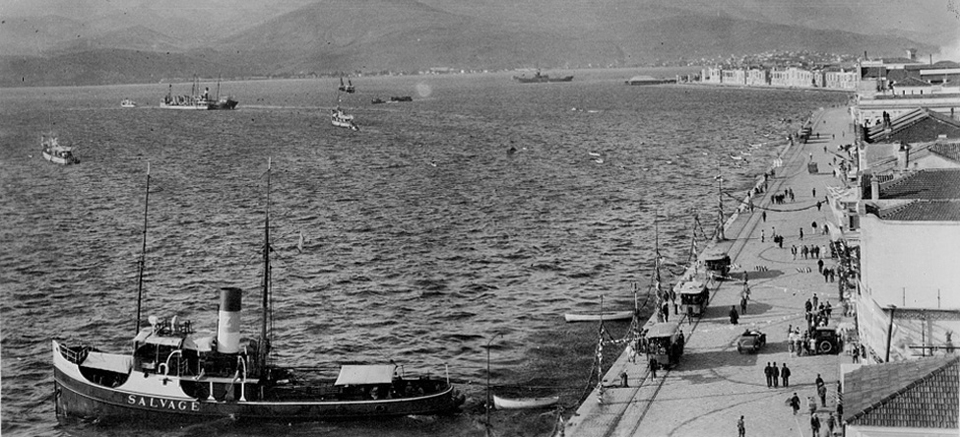

The Interviewees

Interview with Semih Sefer, August 2026
1- Your PhD thesis you graduated with in 2017 was titled ‘The Lorando and Tubini Families: Bankers Operating in the Ottoman Empire.’ Money exchangers were numerous and came from diverse ethnic groups right back to the 16th century Jews from Iberia who found refuge in the Ottoman lands. Did the Levantine Lorando and Tubini (and some prominent Greek) banking enterprises represent a more defined modern type of banking in the 19th century, beyond informal money lending / usury, whereby under Islamic law, Muslims were prevented from practicing. Or was it a case of the state over-spending and these families filled a vacuum, backed by the force of French navy, if things came to head?
To view 19th-century Ottoman bankers merely as moneylenders or money changers charging high interest rates leads to an incomplete understanding of the financial transformation of the period. However, equating them with fully-fledged commercial banks in the modern sense would also be an anachronistic approach. A more accurate assessment is to regard the Galata bankers as a transitional financial institution bridging the gap between traditional money-changing and modern banking. The Lorando and Tubini families are among the most striking examples of this transformation.
Nineteenth-century Ottoman public finances were in constant need of short-term capital due to chronic budget deficits, irregular tax collection, war financing and problems with cash flow. This need was the fundamental structural factor that paved the way for the rise of the Galata bankers. Indeed, as noted in our study, the bankers contributed to the state’s long-term financial survival and became influential actors not only in economic but also in political and diplomatic processes. Consequently, the rise of the Lorando and Tubini families was, first and foremost, a consequence of the financing gap created by the Ottoman state’s public finances. Had the central treasury possessed sufficient liquidity, there might not have been such a great need for short-term, high-interest advances and banker financing.
However, it would also be incorrect to define the Lorandos and Tubinis solely as creditors financing the state. As our study demonstrates, particularly following the Tanzimat reforms, the Galata bankers established direct links with European financial markets, became key players in the Istanbul Stock Exchange, conducted foreign exchange transactions, provided credit to both the state and the private sector, established trading companies and financial institutions, and operated as entrepreneurs in various sectors.
This transformation is most clearly evident in the financial ventures established by these families. The role of the Tubini family in initiatives such as the Şirket-i Maliyye (Union Financière) and, subsequently, the Türkistan Bankası (Bank of Turkey Société Anonyme) demonstrates an effort to establish a corporate financial organisation, going beyond that of a mere capital provider. Subsequently, the Crédit Général Ottoman (İtibar-ı Umûmî-i Osmânî Bankası) venture became one of the key examples of the transition from traditional banking to the joint-stock bank model.
The partnership established by the Tubini family with Société Générale during the 1868–1869 loan issues represented a further step forward. During this process, George Tubini & Sons operated not merely as a firm providing credit, but as the Istanbul branch of a financial organisation responsible for the international marketing of Ottoman government bonds. Indeed, the new bank planned to be established for the collection of loan proceeds was regarded as significant enough to serve as an alternative to the Ottoman Bank of the time.
A similar development can be observed with regard to the Lorando family. In the 1875 loans, the Lorando Brothers Company was not merely a financier lending to the state. It played an active role in the organisation of state borrowing, the mobilisation of capital and the establishment of relations with international financial circles. Similarly, their shift from banking activities to mining operations and tramway investments after 1881 indicates that they moved beyond traditional credit activities by channelling their capital into productive sectors.
Consequently, banking families such as the Lorandos and the Tubinis should be regarded not only as a product of the structural void in the Ottoman financial system, but also as capitalists who sought to fill this void with modern banking techniques and contributed to the institutionalisation of the Ottoman financial market. In this respect, they represent one of the most emblematic examples of hybrid financial institutions situated between traditional Galata money-changing and modern investment banking.
2- How risky was banking as a commerce in the 19th century Istanbul? Was it a case of high risk / high potential rewards, or were the bankers the facilitators of foreign government loans, so they were not so exposed, but presumably were still ‘bond holders’? Did the state which became increasingly indebted and finally declaring bankruptcy in 1875 provide solid collateral, such as prime real-estate, that could be ‘cashed in’ when it defaulted on debts?
In 19th-century Istanbul, banking was a profession characterised by high risk and high returns. Bankers were not merely intermediaries earning commissions between European capital and the Ottoman State. They were financial institutions that exposed their own balance sheets to significant risk, often held government bonds in their portfolios, granted short-term advances, and could suffer direct losses should borrowing operations fail. However, the risk was not entirely unsecured. The state sought to enhance the credibility of its credit by offering tax revenues and certain public revenues as collateral. Yet these guarantees were, in essence, ‘revenue assignments’ rather than ‘first-class properties’ mortgaged in the modern sense.
The international financial system that developed in Europe during the 19th century had created a new financial order in which commercial banks channelled the savings of the middle classes into government bonds. Ottoman borrowing also became part of this network. However, the bankers operating here did not merely act as intermediaries in the sale of bonds. They organised the issuance of debt, held the bonds in their own portfolios, underwrote the unsold portion when necessary, and also met the state’s short-term financing needs. Consequently, they were exposing their own capital to direct risk.
The primary source of risk lay in the financial structure of the Ottoman State. From the 1860s onwards in particular, the state had become increasingly dependent on short-term domestic loans, followed by external borrowing. A significant proportion of the bankers were investing in government bonds or underwriting their sale. Consequently, when the state’s ability to pay weakened, it was not only their commission income but also their capital itself that was put at risk.
The 1875 moratorium is the clearest example of this. The default caused serious losses not only to the Ottoman Treasury but also to the bankers holding Ottoman bonds, investment banks and bondholders in Europe. Consequently, restructuring negotiations spanning many years emerged following 1875. Indeed, one of the central arguments of my new study is that international debt relations were not merely a matter of a ‘debtor state–dispersed bondholders’ relationship, rather, bondholders became institutionalised over time and, by acting collectively, emerged as active players in restructuring processes.
For another example, the Crédit Général Ottoman initiative was not merely a brokerage activity securing credit on behalf of the state. The Tubini partnership was a direct part of the international consortium. It was actively involved in the financial network spanning Paris, London, Amsterdam and Istanbul. In this way, it shared in both the success of the issue and the market performance of the Ottoman bonds. Similarly, the role of the Lorando Brothers Company in the 1875 loans was not limited to mere brokerage. The company played an active role in organising state financing and thus became directly dependent on the state’s ability to pay. Consequently, the moratorium also affected banking families such as the Lorandos and the Tubinis.
Following the 1875 bankruptcy, the system of guarantees became even more institutionalised. First through the Rüsûm-ı Sitte Administration, then via the Muharrem Decree and the Ottoman Public Debt Administration (OPDA), specific revenue sources were placed directly under the management of the creditors. Consequently, the guarantee offered by the Ottoman State was not, in the modern sense, ‘mortgaged property’, but rather the allocation of specific public revenues. From the creditors’ perspective, the primary guarantee lay not in immovable property but in tax sources that generated a steady income.
In conclusion, 19th-century banking in Istanbul should be defined as a financial activity based on the principle of high risk–high return. Banking families such as the Lorandos and Tubinis were not merely brokers channelling foreign capital into the Ottoman Empire. They were financiers who tied their own capital to government bonds, extended short-term loans and assumed direct responsibility for organising international borrowings. Consequently, the 1875 moratorium seriously affected their financial positions as well. That said, the risk was not entirely unsecured. In order to ensure creditworthiness, the Ottoman Empire had allocated tax revenues—such as the tithe, customs duties and other public revenues—as collateral rather than real estate. Following the bankruptcy, this system was institutionalised through the OPDA. In this respect, the Ottoman financial system presented a transitional model evolving from banking based on personal trust to international debt management based on revenue collateral.
3- In 2024, you successfully defended his thesis entitled ‘The Consolidation of Ottoman External Debts: Tevhid-i Düyun (1901–1903)’ and was awarded a PhD. Six years after the Ottoman Empire being unable to pay the interest on its massive dept, as part of the Muharrem Kararnamesi (Decree of Muharrem) on 15 October 1881, the overall public debt was reduced and the Ottoman Public Debt Administration (OPDA) was established. This made the European creditors bond-holders and assigned special rights to the OPDA for collecting various tax and customs revenues within the Ottoman Empire. Was the 1901-3 ‘consolidation’ advantageous for the Empire?
The operation to consolidate and restructure the Ottoman external debt in 1903 (tevhîd-i düyûn) was not merely a continuation of the 1881 Muharrem Decree, but rather the second major financial operation in which the Ottoman Empire sought to renegotiate its external debt regime in its favour, following approximately twenty years of regular debt repayments. One of the study’s key findings is that the Ottoman Government entered the 1901–1903 negotiations from a much stronger financial and diplomatic position than it had in 1881. As the Muharrem Decree was being drawn up, the state was in default and had been forced to accept the terms of its European creditors to a large extent. In contrast, during the tevhîd-i düyûn negotiations, it was able to significantly increase its bargaining power thanks to its track record of regular repayments.
For this reason, the primary objective of the operation was not merely to reduce debts, but to consolidate the numerous external debt series—each with different interest rates and repayment terms—into a single system, thereby alleviating the annual debt service burden on the Ottoman treasury, simplifying the repayment schedule and enhancing its credit standing in the capital markets. In my study, this process is defined as the ‘consolidation and conversion of debts’ and is assessed as a comprehensive financial restructuring rather than a classic debt rescheduling.
However, the operation was not merely a financial negotiation but also a diplomatic one. As demonstrated in the study, the associations of British, French, German and other foreign bondholders acted for the first time within a highly institutionalised framework. Extensive negotiations were conducted between the banking consortium and the Ottoman Government, and the final agreement could only be drawn up through mutual concessions. Consequently, the resulting arrangement was not a unilateral imposition, but the outcome of a comprehensive compromise between the Ottoman Government and the international creditor community.
One of the most significant advantages gained from the Ottoman State’s perspective was that the annual debt service became more manageable and the financial burden was reduced. The study argues that, thanks to the new arrangement, the state generated revenue from debt management, simplified the payment system, paved the way for the renewal of trade agreements, and, in particular, strengthened the financial confidence required for major investment projects such as the Baghdad Railway. Furthermore, the state benefited to a certain extent from the sharing of surpluses in the OPDA revenues. For this reason, the operation is not regarded as a measure serving solely the interests of the creditors.
However, despite these positive aspects, the operation did not completely free the Ottoman Empire from external financial supervision. The OPDA continued to exist, foreign oversight of the allocated revenues persisted, and the major European powers continued to use financial matters as a tool of diplomatic influence. My study demonstrates in particular that the rivalry between France, Germany and Britain was directly reflected in the tevhîd-i düyûn process, and that external debts became not only an economic issue but also an element of international politics.
Consequently, the study concludes that the operation was a successful restructuring carried out on more balanced terms in favour of the Ottoman Empire, in accordance with the 1881 Muharrem Decree, which facilitated debt management and reduced the financial burden. However, this success did not mean that the Ottoman Empire had regained full financial sovereignty. External financial oversight and the influence of European capital on the Ottoman finances continued. Nevertheless, by increasing its bargaining power compared to 1881, the state succeeded in partially altering the terms of this oversight in its favour. For this reason, within the framework of the conclusions reached in this book, the tevhîd-i düyûn should be regarded not as financial independence, but as a pragmatic restructuring that strengthened financial sovereignty and revised the external debt regime in the Ottomans’ favour.
4- There is no shortage of prominent successful Levantine families in commerce in late 19th century Istanbul, such as Whittalls, Bakers, Glavany, D’Andria etc. Why did you pick on the Foscolo family for this study?
Although there were studies on the families you mentioned, there had been virtually no systematic academic research into the Foscolo family. However, when archival documents, the Annuaire Oriental yearbooks, church records, the Levantine Heritage Foundation archive and certain other sources were brought together, a remarkably rich dataset emerged. Consequently, rather than retelling the story of a well-known family, this study aimed to fill a significant gap in the literature.
An examination of the occupational distribution in the article reveals that they were active in a wide variety of fields, including banking, trade, craftsmanship, engineering, shipping agency, company management, the arts and public service. The primary reason for selecting the Foscolo family was not simply that they were the wealthiest Levantine family. Despite having been largely overlooked in Ottoman historiography, they offered the opportunity to trace virtually every aspect of 19th-century Istanbul’s economy through a single family. The Foscolos were active in a wide range of sectors, from banking to maritime transport, and from joint-stock companies to the coal trade. Consequently, my study has moved beyond a mere family monograph to become a microhistorical investigation explaining the economic transformation of Pera. I therefore chose the Foscolo family not because they were an exceptional example of Ottoman Levantine society, but because they were one of the few families capable of representing the economic transformation of the 19th century in all its dimensions.
5- Apart from the commercial registers what were your chief sources of information during your research on the commercial activities of the Foscolo family.
Commercial register records formed a significant part of my research. However, the study was underpinned by a multidisciplinary approach to source use. It was not possible to trace the activities of the Foscolo family through a single series of documents. I therefore sought to reconstruct the family’s history by bringing together different types of primary sources.
Firstly, I utilised documents from the Ottoman Archives, specifically those held in the Ministry of Foreign Affairs, the Consular Affairs Department, the Trade Department, the Yıldız Collection and other relevant fonds. Thanks to these documents, I was able to trace the family members’ citizenship matters, commercial disputes, company activities and their relations with the state. In this article, documents from the Ottoman Archives in particular constitute one of the primary sources regarding the family members’ migration, corporate activities and maritime ventures.
Secondly, I made systematic use of the Annuaire Oriental. This source was one of the most important databases for my research. Thanks to the annual directories, I was able to track the family members’ addresses, occupations, companies, agencies and changes over the years, thereby compiling a long-term dataset. This allowed me to prepare tables illustrating occupational distribution and chronological development.
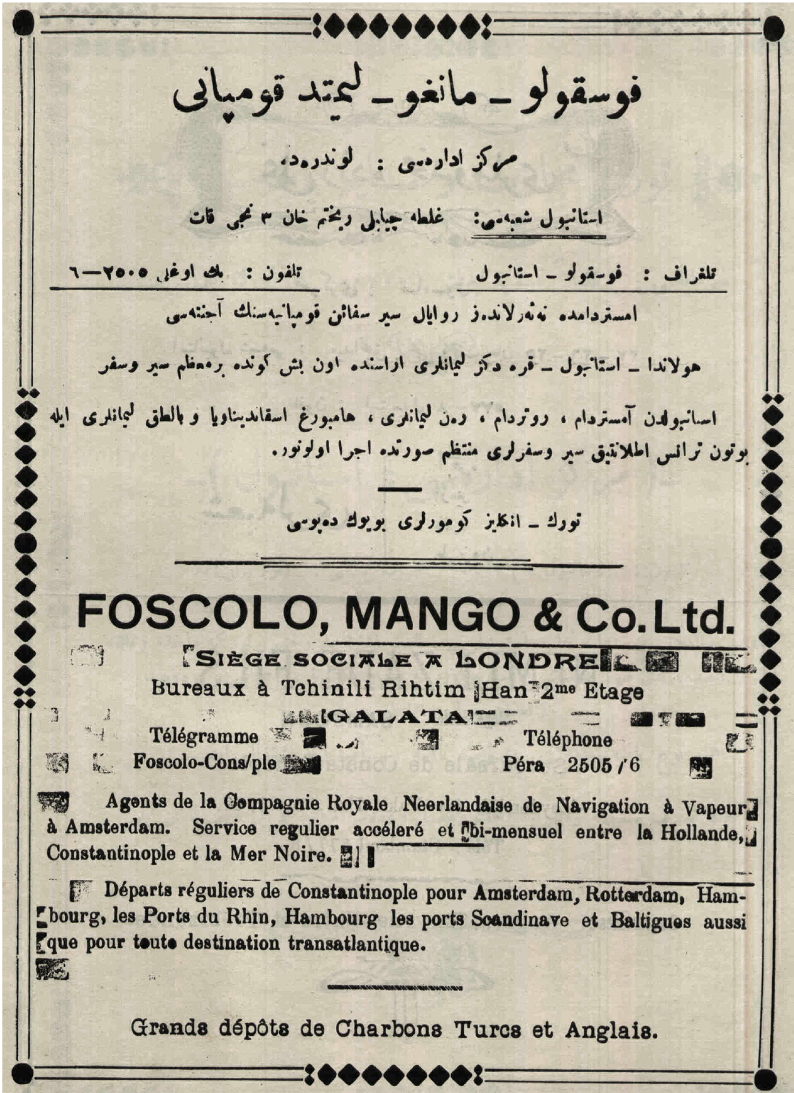
Grand Annuaire Illustré / Büyük Salname entry for the company 1925-26.
Thirdly, I made use of Levantine church records. In particular, baptism, marriage and death records enabled me to uncover the kinship ties of family members, their migration patterns and the processes by which they settled in Istanbul. The Latin church records published by Rinaldo Marmara were particularly significant in this regard.
Fourthly, I utilised newspapers from the period. Through newspaper advertisements, company announcements, steamship schedules and commercial notices, I was able to track the activities of the Foscolo & Mango Steamship Company in detail. In particular, the newspapers served as a complementary source regarding the company’s shipping routes and commercial operations.
In addition to these, I utilised the Lloyd’s Register of Shipping, Mike Foscolos’s book based on the family archive, the company’s records from the period, and secondary literature. In particular, the Lloyd’s Register records made it possible to track the company’s maritime activities on an international scale.
Consequently, my study is not based solely on commercial register records. By utilising Ottoman archival documents, the Annuaire Oriental, Latin Church records, period newspapers, international shipping records and the family archive together, I compared different sources. In this way, I endeavoured to reconstruct both the biographies of family members and their commercial activities over an extended period of time.
6- The Foscolo family were Venetian in origin but like many Levantine families, generations before moving to Istanbul / Izmir spent a long residency in the former Venetian possession of Tinos island. Do we have much information on just how long they stayed on the island, what trade they practiced and to what extent they became ‘Hellenised’ in terms of language / religion?
The history of the Foscolo family on Tinos has proved to be one of the most challenging aspects of this research. Whilst Ottoman archival documents allow for a detailed examination of the family’s activities in Istanbul and Izmir, direct sources relating to the period they spent on Tinos are rather limited. For this reason, I have endeavoured to reconstruct this section by drawing on Ottoman archives alongside Latin church records, studies on the island’s history and, in particular, Mike Foscolos’s comprehensive work on the family history - book excerpt. The available data indicate that the Foscolo family’s origins lie in the Venetian aristocracy, that one branch of the family, having settled in the Aegean during the period of Venetian rule, lived on the island of Tinos for several generations and that it was only from the late 18th century and early 19th century onwards that they migrated to Kavala, Izmir and Istanbul. As for their commercial activities on Tinos, we do not have detailed company records or account books at our disposal.
However, the fact that the family quickly engaged in significant ventures in areas such as maritime transport, ship agency, coal trading, banking and international trade after arriving in Ottoman territories suggests that their knowledge and experience of Mediterranean trade networks may have been shaped during their time on Tinos. However, no documents are as yet available to prove this directly. We have clearer data regarding language and religion. The majority of the Latin community in Tinos gradually adopted Greek in daily life, whilst retaining their Catholic identity. The Foscolo family also appears to have followed this general Levantine pattern.
Indeed, the fact that family members appear in the baptismal records of Tinos, that the same family later reappears in the Latin churches of Istanbul, and that family members chose between Austrian, Italian, French and Greek citizenship, demonstrates that they were a multi-layered Levantine family who had become partially Hellenised ethnically, yet retained their Latin-Catholic identity in religious and cultural terms. At this point, I would like to emphasise the importance of the family history study compiled by Mike Foscolos. He has meticulously traced the family’s genealogy, its various branches and its movements across the Mediterranean, starting from the Venetian period, and has enabled me to place the individuals I identified in the Ottoman archival documents within the correct family lineage. This valuable work has significantly added historical depth to my research.
7- Through the Annuaire Oriental yearly (1868-1921) trade almanac publication you were able to find out the professions of the various members of the Foscolo family, which included artisan / craft occupations as well, such as music-teacher (Francois Foscolo, 1868), blacksmith (Nicolo Foscolo, 1868) etc. Was this a surprise for you or is it a case of us not in direct research of this subject assume Levantines were usually connected with ‘monied’ professions?
No, this came as no surprise to me. In fact, although there was a widespread perception, prior to my research, that the Levantines consisted solely of families of bankers, major merchants or industrialists, it is clear that this is an incomplete assessment when one considers the cosmopolitan nature of Ottoman Istanbul. Neighbourhoods such as Pera and Galata were not merely centres of international trade and finance, but also dynamic economic hubs where a wide variety of social and professional groups lived side by side. The Levantine community did not constitute a homogeneous elite class, it exhibited a broad professional diversity, ranging from bankers to merchants, shipping agents to artisans, and teachers to artists. Indeed, the fact that the Annuaire Oriental records list François Foscolo as a music teacher and Nicolo Foscolo as a blacksmith clearly demonstrates the economic and social diversity of Levantine society. The presence, in later years, of bankers, merchants, shipping agents, company directors and entrepreneurs involved in the maritime trade within the same family further illustrates that this diversity persisted over time. Consequently, one of the key findings of my study is that it challenges the traditional view which equates the Levantines solely with families possessing substantial capital. The example of the Foscolo family shows that the Levantines were present at every level within Istanbul’s cosmopolitan economic structure and were capable of social mobility across a broad spectrum of activities, ranging from craftsmanship to trade, and from finance to international companies. Consequently, coming across artisan trades was not an unexpected development for me. On the contrary, it was a significant finding that confirmed the multi-layered structure of Levantine society.
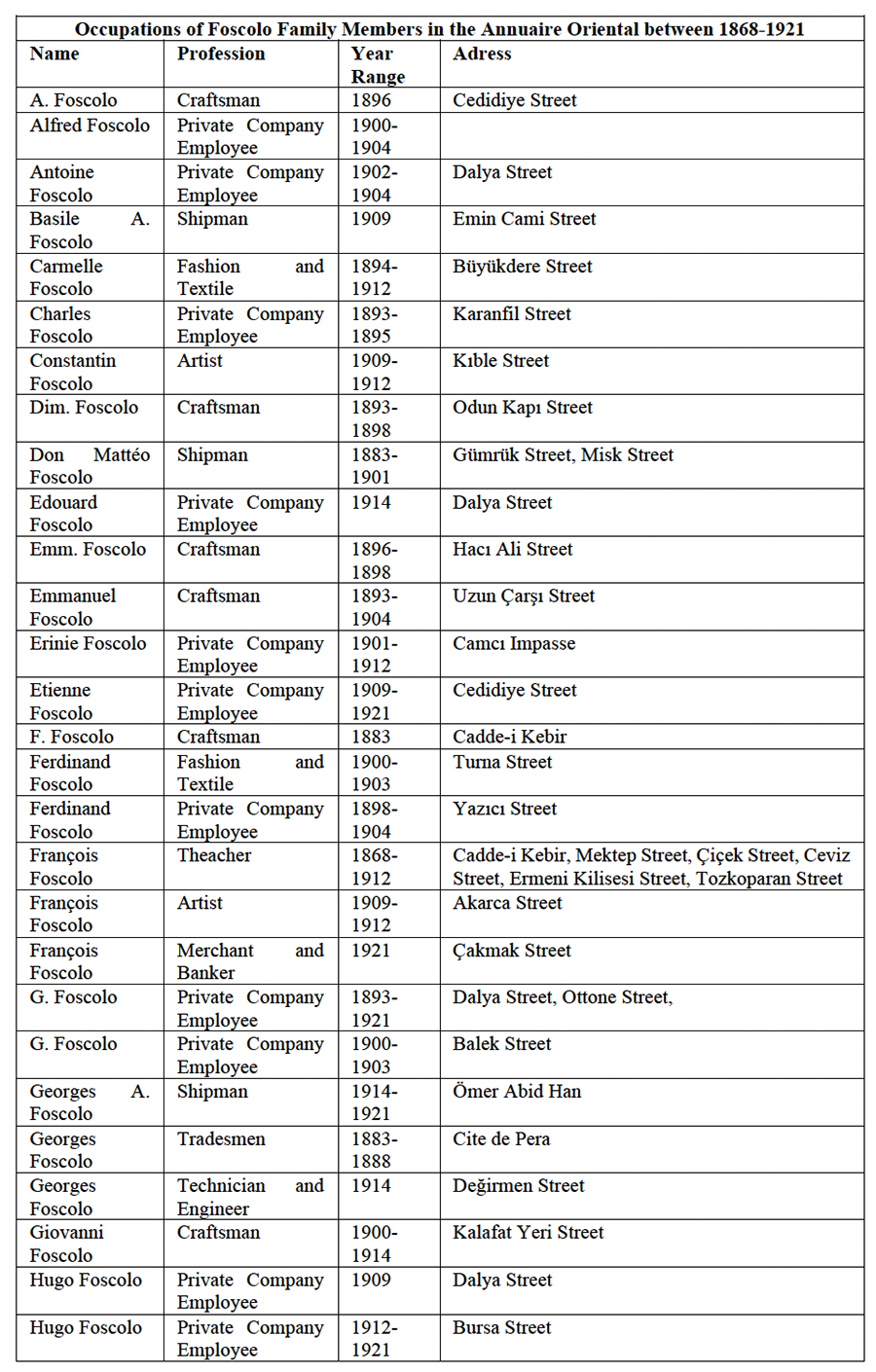
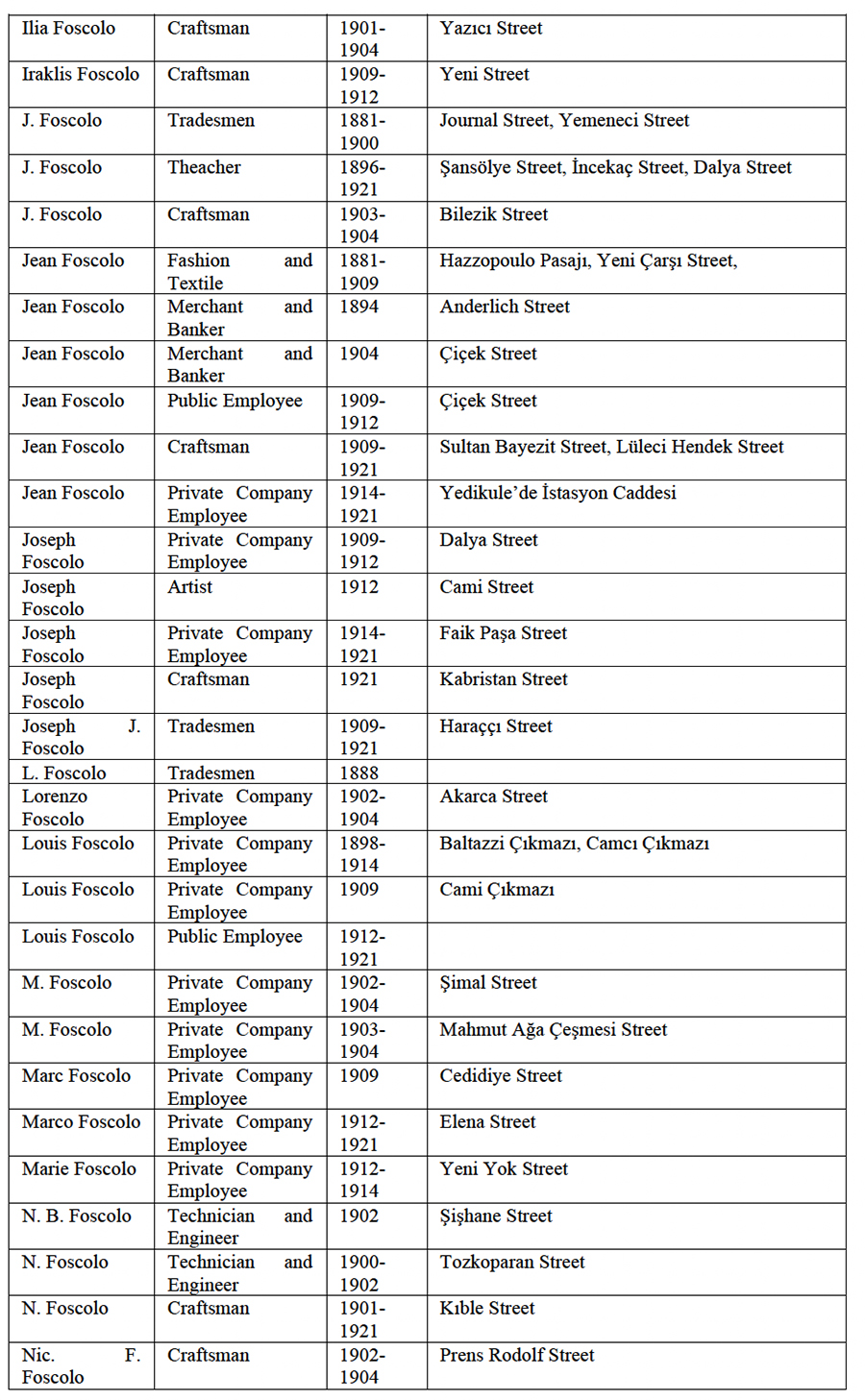
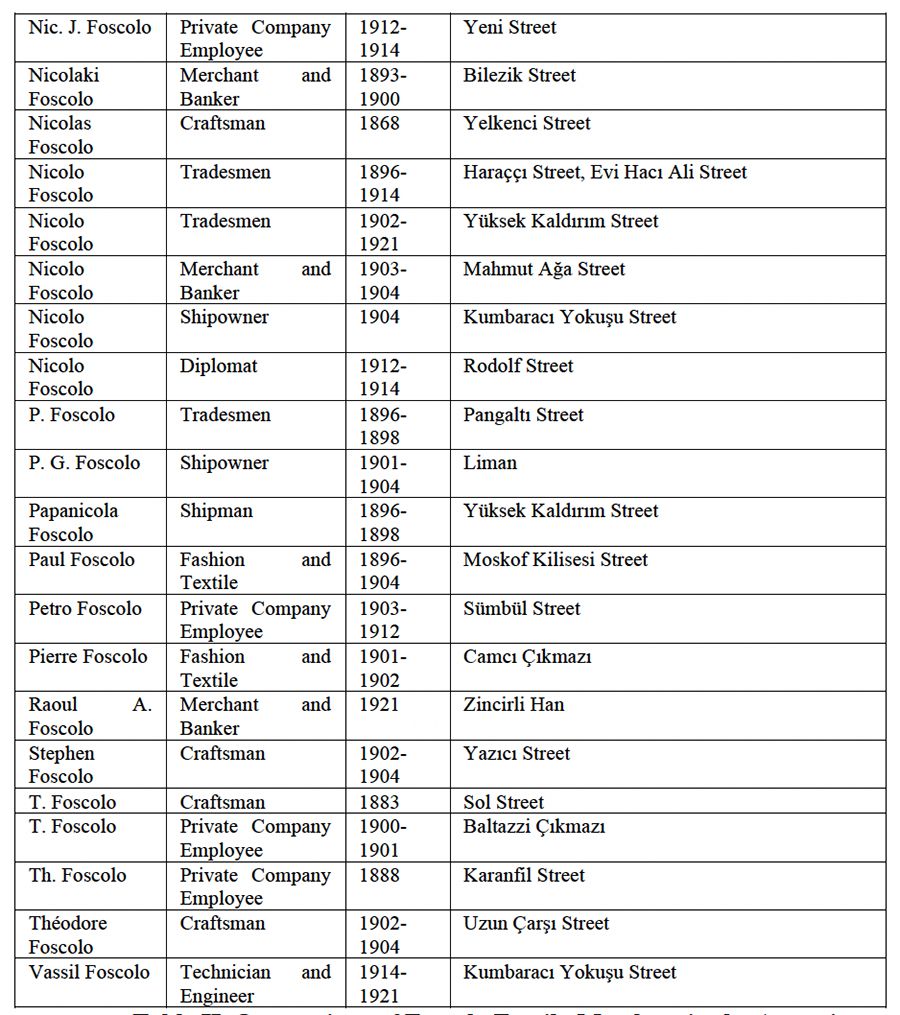
Listing of Foscolo family members occupations and addresses extracted from issues of Annuaire Oriental.
8- Luigi Foscolo applied for Ottoman citizenship as you showed in your presentation. Do we know if that application was successful and what advantages could that bring in terms of his trade activities?
I was able to establish from documents in the Ottoman Archives that Luigi Foscolo had applied for Ottoman citizenship. However, within the scope of the present research, I was unable to locate a definitive document showing that this application had been definitively accepted. I have therefore taken particular care to avoid drawing any definitive conclusions on this matter. Nevertheless, it can be said that, had the application been accepted, it would have afforded significant advantages, particularly in terms of commercial activities. Although becoming an Ottoman citizen would have meant relinquishing the privileges enjoyed by foreign subjects under the capitulations, it could, in return, have offered opportunities such as the acquisition of immovable property, the ability to conduct certain commercial transactions more easily, greater ease in dealing with the local bureaucracy, and the freedom to operate more comfortably within the Ottoman legal system. For certain Levantine families who had lived in Istanbul for a long time and aimed to establish their commercial activities on a permanent basis, such applications could be regarded as pragmatic choices. However, we do not yet have sufficient data on the grounds upon which Luigi Foscolo’s citizenship application was decided, nor on how this affected his commercial activities. For this reason, rather than being one of the conclusions reached in the present study, this issue is one of the research topics I plan to examine in greater detail in the future. In particular, I believe that new investigations I will conduct into various archival collections and consular documents will yield clearer results regarding the outcome of the application and its possible effects.
9- In your presentation you didn’t display a family tree of the Foscolos through the generations, though perhaps you did work on one? Do the various marriages point to a mostly Levantine of similar island origin in these unions, or do we see a sprinkling of non-Muslim other native minorities also listed?
As part of this study, I have not compiled a detailed, multi-generational family tree. The main reason for this is that, although Ottoman archival documents do record family members during specific periods and in the context of specific events, they do not provide sufficient data to link all generations together comprehensively. Nevertheless, the records I have accessed—particularly baptismal records, the family archive and other sources—indicate that the Foscolo family primarily established marital ties with families of Levantine, Catholic and Aegean island origins. This is consistent with the social and economic networks of mutual support commonly found within the Levantine community of the period.
Nevertheless, the data currently at our disposal is not sufficient to reveal the full extent of the marriage network. I therefore believe it is still too early to make a definitive assessment of the scope of marriages formed with other non-Muslim Ottoman communities. This issue may be clarified much more clearly in the future, particularly through research I plan to conduct in church, municipal, consular and family archives in France and Italy. Indeed, in my research on the Lorando and Tubini families, I was able to construct detailed family trees by drawing on archives and family records held abroad. This experience demonstrated to me that the history of Levantine families can be fully reconstructed not only through Ottoman archives but also through the combined use of international archives. Similarly, Mike Foscolos’s comprehensive study on family history serves as an extremely valuable starting point in this regard. The information he has provided on family trees and family branches has been of great assistance in enabling me to place the individuals I identified in the Ottoman archives within the correct family line. I believe that in the future, by supplementing this study with archival documents from France and Italy, it will be possible to present the Foscolo family’s multi-generational family tree and marriage networks in much greater detail.
10- The Foscolo & Mango Steamship company was clearly successful. Do you think that both these families who were able to bring their long residence in the Levant to the knowledge mix of where and how to ply their trade was part of the success of the company? What were the chief cargoes carried?
Yes, I believe this is one of the key factors explaining the success of the Foscolo & Mango Shipping Company. The findings of my research show that the Foscolo and Mango families were not merely capital-owning entrepreneurs, but also Levantine families who had been familiar with the world of Mediterranean trade for generations. The Foscolo family’s migratory journey from Venice to Tinos, and from there to Kavala, Izmir and Istanbul, together with the Mango family’s presence within the Eastern Mediterranean trade networks, ensured that both families gained an intimate understanding of Levantine ports, regional trade practices, different legal systems and international trade circles. This accumulated knowledge provided a significant advantage, determining not only in which ports they would operate, but also which foreign companies to partner with, which routes were economically more profitable, and how to develop their international agency networks. Indeed, the fact that the company quickly became the general agent in Istanbul for the Amsterdam-based Cie Royale Neerlandaise de Navigation à Vapeur, the Orient Line, and various British and German shipping companies, and was subsequently able to open branches in Piraeus and London, clearly demonstrates the decisive role played by these international Levantine networks in its commercial success.
As regards the cargo carried, whilst we do not possess detailed cargo manifests, the company’s sphere of activity and the organisations it represented provide significant clues. The company engaged in both passenger and freight transport, operating regular services between Istanbul and Gallipoli, Çanakkale, Lesbos, Izmir, Chios, Tinos, Syros, Chania and Candia. Furthermore, one of the company’s most significant activities was acting as a coal agent. Its representation of the National Steam Coal Company, the Abercarn Coal Company, the London & South Wales Coal Company and, later, the United National Coal Works demonstrates that hard coal—the fuel for steamships—occupied a very important place within the company’s operations. Furthermore, as a Levantine agency operating a regular shipping service, it is highly likely that the company acted as an intermediary in the transport of textile products, manufactured goods, various commercial commodities between Europe and Ottoman ports, as well as agricultural products shipped from Ottoman ports to Europe.
11- Do we insights into how the Foscolo family adjusted to the whole new circumstances that were brought in with the break-out of WW1? Do you think industries requiring considerable and continuous investment such as a shipping line no longer was so conducive to manage with both dangers of state confiscation and also presumably a push-back from the emerging state that wished to play a prominent role in this strategically significant trade?
My research shows that the Foscolo family experienced a marked decline in their activities following the First World War. However, it is clear that this was not a situation unique to the family. The economic and political upheaval caused by the war affected a significant proportion of Levantine entrepreneurs. In the second half of the 19th century, the Foscolo & Mango Shipping Company had established a highly successful enterprise through the international network it had built between Istanbul, Piraeus and London, acting as agents for Europe’s leading shipping and coal companies. However, with the outbreak of the First World War, maritime trade ceased to be merely an economic activity and became a strategic arena subject to direct state intervention. Developments such as the seizure of ships, the placing of sea routes under military control, rising insurance costs and the fragmentation of international trade networks severely restricted the operations of Levantine companies. As I noted in my article, the war had a marked impact on the occupational distribution of family members, and a decline in traditional commercial activities was observed.
Furthermore, the gradual adoption of a national character by economic policies during the transition to the Republic also narrowed the scope of operations for companies with foreign or Levantine capital. Operating in sectors such as maritime transport—which require high capital, demand continuous investment in fleets and are directly affected by state policies—became much more difficult than before. For this reason, it is not sufficient to explain the decline in the Foscolo family’s influence in the maritime sector solely in terms of the company’s own success or failure. Underlying this are structural factors such as the war economy, shifting international trade balances and the economic priorities of the new state. However, within the scope of my research, I was unable to access sufficient documentation to detail the company’s liquidation process following the war or the subsequent economic strategies of the family members. I have therefore refrained from drawing definitive conclusions on this matter. However, the available findings indicate that the First World War and the political and economic transformations that followed marked the beginning of a new era not only for the Foscolo family but also for the majority of Levantine entrepreneurs who had risen to prominence within international trade networks during the final period of the Ottoman Empire.
12- Do any of the commercial buildings of the Foscolo in Istanbul still survive?
Within the scope of my current research, I have been unable to identify a commercial building or company headquarters that can be definitively proven through documents to have belonged to the Foscolo family and whose commercial properties have survived to the present day. However, it is possible to trace the commercial premises where the family carried out its activities. Thanks to the records in the Annuaire Oriental and Ottoman Archives, I was able to establish that the Foscolo & Mango Shipping Company operated first at Sandalcı Han, then at Couteaux Han, followed by Arabian Han and, finally, at Çini Rıhtım Han. That said, these buildings were commercial centres that the company rented or used for its operations. I have not been able to find any document indicating that they were directly owned by the Foscolo family. In contrast, the historic building known today as Casa Foscolo in Beyoğlu stands as an important legacy commemorating the family’s presence in Istanbul. Although this building was not the direct headquarters of the Foscolo & Mango Shipping Company, it can be regarded as one of the most tangible examples of the Foscolo family’s historical footprint in Beyoğlu that has survived to the present day. In this respect, it is fair to say that the family left its mark not only in commercial life but also in the urban and architectural memory of Beyoğlu.
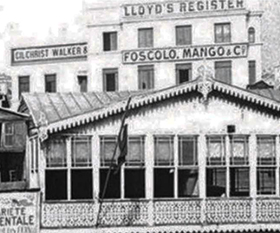
Foscolo offices sign seen amongst other shipping and insurance agents’ in Galata in early 20th century.

Casa Foscolo, now serving as an upmarket hotel in Beyoğlu, opened 2024. According to information on the web, the building was first constructed between 1890 and 1900 as a pioneering apart-hotel for Foscolo Mango & Co. Ltd., a maritime business founded in Istanbul by the Venetian Foscolo family. In the 1930s, the German Holstein family took over, transforming the ground level into a culinary destination and the upper floors into commercial hubs.
13- Is there more research that can be conducted on the activities of the Foscolo family and if so which areas would you concentrate on?
I believe this research is, in fact, merely a starting point. In this study, I have sought to shed light on the Foscolo family’s economic activities, occupational distribution and, in particular, their maritime ventures in 19th-century Istanbul. However, during the course of my research, I encountered new questions as well as those I was able to answer. Consequently, I plan to focus my future work on a few key areas. Firstly, I wish to map out the Foscolo family’s multi-generational family tree in greater detail. It is clear that this cannot be achieved using Ottoman archives alone. Through research into church, municipal, consular and family archives in France and Italy, the kinship ties between family members, their marriage networks and the branches of the family spread across different countries can be traced much more clearly. I was able to construct detailed family trees by applying this method in my research on the Lorando and Tubini families. I believe a similar approach will yield significant results for the Foscolo family as well.
In this regard, Mike Foscolos’s comprehensive study on family history also provides an extremely valuable foundation and serves as an important reference for future research. Secondly, I wish to examine the migration process between Tinos, Kavala, Izmir and Istanbul in greater detail. In particular, the family’s economic activities on Tinos, the specific trade sectors in which they specialised, and how their Levantine identity took shape remain among the questions awaiting answers. Thirdly, I aim to examine the commercial activities of the Foscolo & Mango Shipping Company in greater detail. By utilising Lloyd’s archives, insurance records, port records and cargo manifests, the nature of the cargo transported, the volume of trade, the company’s financial performance and its relations with European shipping companies can be elucidated in much greater detail. Fourthly, I wish to focus on the Foscolo family’s property holdings and urban heritage. In particular, the ownership history of buildings associated with the family, notably Casa Foscolo, can be examined through land registry records, municipal archives and cadastral documents. This will enable a clearer understanding of the family’s role in the spatial development of Beyoğlu and Galata.
Finally, I believe that the economic and social transformation of the Foscolo family during the transition to the Republic warrants a separate research topic. The First World War, the abolition of the capitulations, national economic policies and the early years of the Republic profoundly affected not only the Foscolo family but all Levantine entrepreneurs. Questions such as how the family adapted to these new conditions, in which areas they directed their activities, and whether subsequent generations chose to continue their lives in Turkey or in Europe have not yet been fully answered. I therefore view this study not as a complete family history, but as the starting point for more comprehensive research into Levantine economic history. Through new archival research in these areas, it will be possible to shed much greater light not only on the economic, social and cultural history of the Foscolo family, but also on that of Ottoman Levantine entrepreneurship in general.
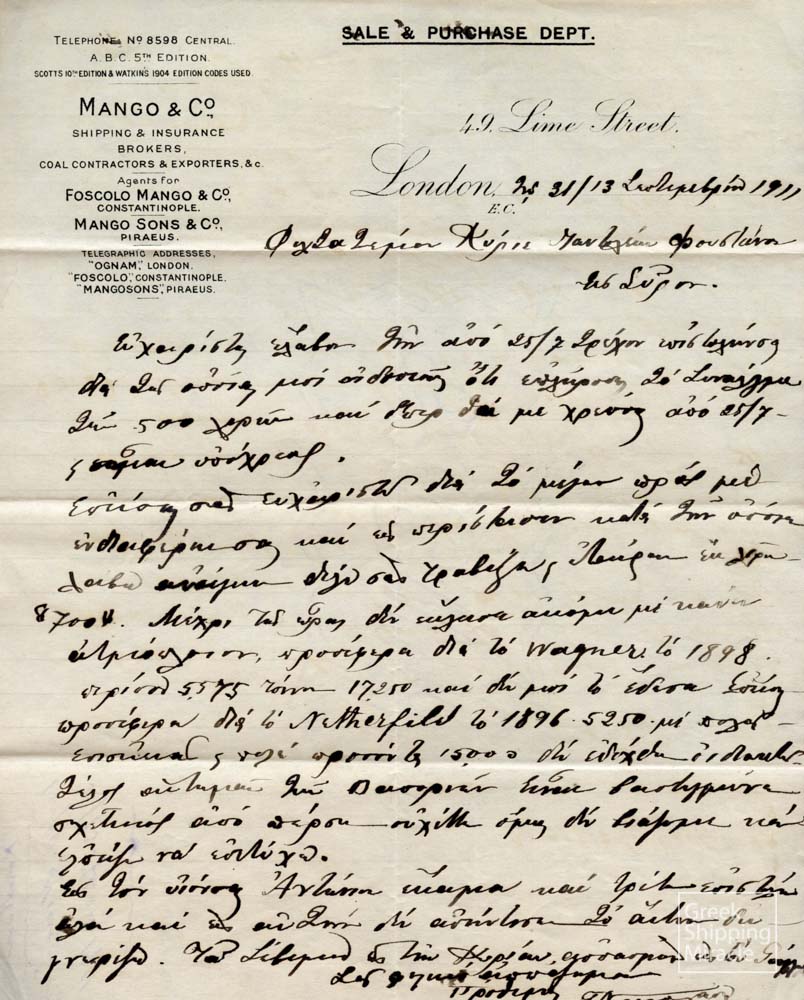
A suggestion of a successor company ‘Mango & Co’ business letter written in Greek from 1911.
To contribute to this ongoing study, please contact me on
Interview conducted by Craig Encer