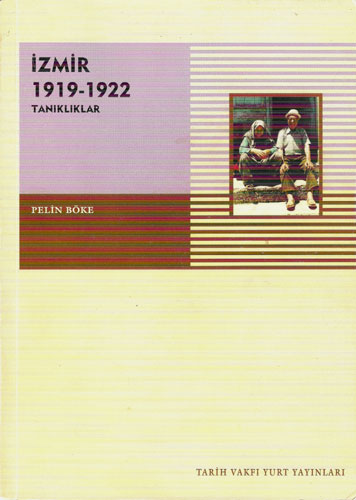
Pelin Böke - İzmir 1919-1922: Tanıklıklar. (Izmir 1919-1922: Testimonies) 2006. Istanbul: Tarih Vakfı Yurt Yayınları. ISBN: 975-333-199-1.
Review by Görkem Daşkan – gorkemdaskan[at]gmail.com, December 2010
As its title reveals, Böke’s book brings together a set of personal testimonies of a group of people, from the period of time between 1919 and 1922 that they lived through as the inhabitants of the then Izmir, while at the same time the city went through a phase which is famously known as the Turkish War of Independence (including the Greco-Turkish War), as well as the occupation of the city by Greece that followed the defeat of the Ottoman Empire in World War I.
This survey, being a unique study in its own right, and a notable contribution to the literature of oral history studies in the related field1 by a Turkish scholar (and her colleagues), is stated to be carried out between the years 1994 and 1999, at several locations in and around Izmir, in collaboration with predominantly Turkish-Muslim (60 by number - two of them being Alawites) as well as 5 Catholic interviewees (Ferdinando Stano (b. 1914), Alexandra Edizel (b. 1913), Eguenie Kokini (b. 1906), Marie Bertuzzi (b. 1916) and Claire Kopri (b. 1912)), the latter who belonged to the Levantine community that preferred staying in Izmir long after the establishment of the Turkish nation-state.
The book actually consists of two chapters, and the first chapter, titled “The Occupied Izmir” (İşgal İzmir’i in the original text) serves as a well-written article that takes a textual photograph of the region at the turn of 20th century in terms of the developing social and political dynamics in the area, and in a way “sets the mood” before getting deeper into conveying the testimonies, and for this reason, aims to facilitate the reader’s understanding and evaluating the follow up material all the better. While the author sticks to the neutral mode of academic narration and its sensibilities throughout her article, one can still distinguish a subtle and somewhat feminine sense of lyricism that is prevalent, which I think, adds a heartfelt sentiment to the overall book.
After this introductory article, there follows the second chapter, “Witnesses Are Speaking” (Taniklar Anlatiyor) that accounts to more than two third of the book. They do indeed speak. These people, all born between the years 1899-1916 (therefore are pretty old women and men during the time of the interviews in contrast to being the youngsters of the time), and severely illiterate or primary school graduates (only 14 out of the 65 are middle and high school graduates), speak from their own points of view, sometimes with a worrying ignorance and hostility, and sometimes with an unexpected glow of straightforwardness and sincerity. In both cases it is not hard to empathise with these people as they exert themselves to the utmost in order to recollect their memories, feelings and thoughts that they had experienced at the time. Along this journey, the reader also gets the opportunity to go back with them to the days of the disintegration of the Ottoman Empire, the forming of Turkish nationalism and the Turkish revolutionary act, the occupation of Izmir and its surrounding by Greek troops, the Turkish troops’ re-entering Izmir and repelling the Greek army away; in other words, the days of outrage, misery and plunder, and of course the Great Fire.
In this context, the testimonies provides us with a spectrum of perspectives ranging from the fact that the Turkish peasants grew poorer before Greece took hold of the area, owing to fact that many had lost their men to the Gallipoli campaign and had to sell their lands to their Greek neighbours at much reduced prices, to evoking that places in Minor Asia like Kemalpasa or Akhisar used to be crowded with Greek inhabitants and Aliağa was famous for the predominantly non-Muslim population (mostly articulated as gavur in the text) that used to live there. Similarly, we find out from these testimonies unusual cases like a pro-Greece Turkish farmer joining his Greek fellows on their “escape”, or a young Turkish man (from Thessaloniki) serving his time in Smyrna under the authority of the Greek gendarmerie, or Turkish bandits breaking into Turkish village to ransack houses were some of the tales encountered. We see once more that though the official ideologies of national history-making do not favour the recounting of stories of native ‘turncoats’ or ‘traitors’, but alas, there they were. And it is no surprise that we read once more, the stories of so-called ‘old Greeks’ who were never really fond of the Greek occupation unlike the younger generations, or an Armenian artisan who gave his consent to converting to Islam in the wake of the Turkish retrieve, yet were not allowed to and was unfortunately shot dead in the end. Beyond doubt, it is quite striking to read someone telling how the Greek tavern keepers at Meyhane Boğazı or Apola Mahala of Smyrna did not let Turkish customers in during Ramadan with a certain degree of altruism or the celebratory scenes of the Apokria carnival on the streets of Smyrna from a first-hand perspective and an illustrative view. As mentioned above, although these stories are (re)told from respective standpoints, they all embrace a certain quality of bitter truth; that is to say, one cannot observe a hint of anachronism or positive nostalgia through these pages.
Comparing the interviewees’ past worldly notions like the fact that the Turkish society circles at the time widely believed that Atatürk’s name and his advent had been told in the Quran in a cryptic manner, or the Levantine interviewees’ expressing that it was, in a way, a means of social capital formation for Orthodox women to marry Catholic men, provide us with clues on the state of religiosity and inwardness of the Turkish society, on the one hand, and the traces of ascending modernism in the Christian upper class, on the other hand.
Perhaps one last paragraph should be devoted to the question of the Great Fire of Smyrna as portrayed in the book. As the reader progresses through the pages, he or she realises that the topic unavoidably comes up in a lot of talks and the interviewees see it somehow necessary to deem a certain ethnic group responsible for the flaming destruction. Surprisingly, a few interviewees put the blame on the Turks and they display a startling degree of politically incorrectness by going against the long held official notions promulgated by both state and general populace, and at such times the book enjoys its most unorthodox moments, yet, it still opts to finish with the “Grescovich Report2” (report on the Fire by Paul Grescovich, the Chief of Smyrna Fire Department) enclosed at the end, which is reported according to the book to be the only official document available on the Fire incident, and is published for the first time in its original entirety in Turkish. The report happens to charge some different groups of people (meaning; excluding the Turkish groups) with the crime of setting the fire. To bring it to light is without a doubt an important effort, yet, after finishing the whole book, one may wonder if such an appendix was fundamental for the entire book.

Review by Görkem Daşkan – gorkemdaskan[at]gmail.com, December 2010
As its title reveals, Böke’s book brings together a set of personal testimonies of a group of people, from the period of time between 1919 and 1922 that they lived through as the inhabitants of the then Izmir, while at the same time the city went through a phase which is famously known as the Turkish War of Independence (including the Greco-Turkish War), as well as the occupation of the city by Greece that followed the defeat of the Ottoman Empire in World War I.
This survey, being a unique study in its own right, and a notable contribution to the literature of oral history studies in the related field1 by a Turkish scholar (and her colleagues), is stated to be carried out between the years 1994 and 1999, at several locations in and around Izmir, in collaboration with predominantly Turkish-Muslim (60 by number - two of them being Alawites) as well as 5 Catholic interviewees (Ferdinando Stano (b. 1914), Alexandra Edizel (b. 1913), Eguenie Kokini (b. 1906), Marie Bertuzzi (b. 1916) and Claire Kopri (b. 1912)), the latter who belonged to the Levantine community that preferred staying in Izmir long after the establishment of the Turkish nation-state.
The book actually consists of two chapters, and the first chapter, titled “The Occupied Izmir” (İşgal İzmir’i in the original text) serves as a well-written article that takes a textual photograph of the region at the turn of 20th century in terms of the developing social and political dynamics in the area, and in a way “sets the mood” before getting deeper into conveying the testimonies, and for this reason, aims to facilitate the reader’s understanding and evaluating the follow up material all the better. While the author sticks to the neutral mode of academic narration and its sensibilities throughout her article, one can still distinguish a subtle and somewhat feminine sense of lyricism that is prevalent, which I think, adds a heartfelt sentiment to the overall book.
After this introductory article, there follows the second chapter, “Witnesses Are Speaking” (Taniklar Anlatiyor) that accounts to more than two third of the book. They do indeed speak. These people, all born between the years 1899-1916 (therefore are pretty old women and men during the time of the interviews in contrast to being the youngsters of the time), and severely illiterate or primary school graduates (only 14 out of the 65 are middle and high school graduates), speak from their own points of view, sometimes with a worrying ignorance and hostility, and sometimes with an unexpected glow of straightforwardness and sincerity. In both cases it is not hard to empathise with these people as they exert themselves to the utmost in order to recollect their memories, feelings and thoughts that they had experienced at the time. Along this journey, the reader also gets the opportunity to go back with them to the days of the disintegration of the Ottoman Empire, the forming of Turkish nationalism and the Turkish revolutionary act, the occupation of Izmir and its surrounding by Greek troops, the Turkish troops’ re-entering Izmir and repelling the Greek army away; in other words, the days of outrage, misery and plunder, and of course the Great Fire.
In this context, the testimonies provides us with a spectrum of perspectives ranging from the fact that the Turkish peasants grew poorer before Greece took hold of the area, owing to fact that many had lost their men to the Gallipoli campaign and had to sell their lands to their Greek neighbours at much reduced prices, to evoking that places in Minor Asia like Kemalpasa or Akhisar used to be crowded with Greek inhabitants and Aliağa was famous for the predominantly non-Muslim population (mostly articulated as gavur in the text) that used to live there. Similarly, we find out from these testimonies unusual cases like a pro-Greece Turkish farmer joining his Greek fellows on their “escape”, or a young Turkish man (from Thessaloniki) serving his time in Smyrna under the authority of the Greek gendarmerie, or Turkish bandits breaking into Turkish village to ransack houses were some of the tales encountered. We see once more that though the official ideologies of national history-making do not favour the recounting of stories of native ‘turncoats’ or ‘traitors’, but alas, there they were. And it is no surprise that we read once more, the stories of so-called ‘old Greeks’ who were never really fond of the Greek occupation unlike the younger generations, or an Armenian artisan who gave his consent to converting to Islam in the wake of the Turkish retrieve, yet were not allowed to and was unfortunately shot dead in the end. Beyond doubt, it is quite striking to read someone telling how the Greek tavern keepers at Meyhane Boğazı or Apola Mahala of Smyrna did not let Turkish customers in during Ramadan with a certain degree of altruism or the celebratory scenes of the Apokria carnival on the streets of Smyrna from a first-hand perspective and an illustrative view. As mentioned above, although these stories are (re)told from respective standpoints, they all embrace a certain quality of bitter truth; that is to say, one cannot observe a hint of anachronism or positive nostalgia through these pages.
Comparing the interviewees’ past worldly notions like the fact that the Turkish society circles at the time widely believed that Atatürk’s name and his advent had been told in the Quran in a cryptic manner, or the Levantine interviewees’ expressing that it was, in a way, a means of social capital formation for Orthodox women to marry Catholic men, provide us with clues on the state of religiosity and inwardness of the Turkish society, on the one hand, and the traces of ascending modernism in the Christian upper class, on the other hand.
Perhaps one last paragraph should be devoted to the question of the Great Fire of Smyrna as portrayed in the book. As the reader progresses through the pages, he or she realises that the topic unavoidably comes up in a lot of talks and the interviewees see it somehow necessary to deem a certain ethnic group responsible for the flaming destruction. Surprisingly, a few interviewees put the blame on the Turks and they display a startling degree of politically incorrectness by going against the long held official notions promulgated by both state and general populace, and at such times the book enjoys its most unorthodox moments, yet, it still opts to finish with the “Grescovich Report2” (report on the Fire by Paul Grescovich, the Chief of Smyrna Fire Department) enclosed at the end, which is reported according to the book to be the only official document available on the Fire incident, and is published for the first time in its original entirety in Turkish. The report happens to charge some different groups of people (meaning; excluding the Turkish groups) with the crime of setting the fire. To bring it to light is without a doubt an important effort, yet, after finishing the whole book, one may wonder if such an appendix was fundamental for the entire book.
1- For further reading in Turkish, especially around the subject of the 1923 population exchange between Turkey and Greece, please see Küçük Asya Araştırmalar Merkezi & Herkül Milas, GÖÇ / Rumlar’ın Anadolu’dan Mecburi Ayrılışı (1919-1923) [The Forced Departure of Greeks from Anatolia, 1919-1923], trans. Damla Demirözü (Istanbul: İletişim, 2002); Mehmet Ali Gökaçtı, Nüfus Mübadelesi: Kayıp Bir Kuşağın Hikâyesi [The Population Exchange: Story of a Lost Generation] (Istanbul: İletişim, 2003); Renee Hirschon, Mübadele Çocukları [Children of the Population Exchange] trans. Serpil Çağlayan (Istanbul: Tarih Vakfı Yurt Yayınları, 2005); and several other books published by “Lozan Mübadilleri Vakfı” (The Foundation of Lausanne Treaty Emigrants) available to be viewed here or at the foundation’s website. For a more detailed account of the books on this subject published, please see the booklist here:
2- İzmir Sigortaları İtfaiye Kumandanı Mösyö Greskoviç’in İzmir Büyük Yangını Hakkındaki Raporu, Istanbul: Bab-ı Saadet karşısında Hüsnü Tabiat Matbaası, 1339, cited in Böke, 2006: 207.
2- İzmir Sigortaları İtfaiye Kumandanı Mösyö Greskoviç’in İzmir Büyük Yangını Hakkındaki Raporu, Istanbul: Bab-ı Saadet karşısında Hüsnü Tabiat Matbaası, 1339, cited in Böke, 2006: 207.
 |