
The Interviewees

Interview with Ben Singer, August 2026
1- Your family research started a few years ago after a chance discovery on the internet of a postcard set by the publisher Jacques Ludwigsohn with an address in Galata. Just how little did you know of your family’s past, and are you surprised just how much of the family’s time in Turkey has been erased? Do you think there were too many painful memories that caused this silence, or was it disinterest as people forged new lives in new lands?
Before I began researching my family history, almost everything I knew of my family’s past was confined to my grandparents’ and parents’ generations (those born in the 1900s and 1910s, and those born in the 1930s and 1940s). I knew next to nothing of the generations that came before them: a handful of stories and anecdotes, and only a vague sense of where the various branches of my family had come from before they settled in Constantinople between the 1840s and the early 1890s (and as I discovered only recently, one branch arrived in Smyrna in the 1730s).
What surprised me at the outset was how little my parents and grandparents knew of earlier generations of our family. Family history before our ancestors’ arrival in Turkey appears not to have been treated as something worth preserving or passing down. As a result, I still do not know the villages, towns or cities of origin of more than half of the family lines which settled in Turkey.
Even more surprising was how much had been forgotten about those generations of our family who actually lived in Turkey. Not just places of residence and the nature of family businesses, but quite dramatic and genuinely significant events involving our family during the second half of the nineteenth and early twentieth centuries had vanished entirely, even from my grandparents’ memories.
Among what was forgotten were the Imperial Ottoman honours and state medals bestowed upon ancestors along four separate branches of my family between the 1890s and the early 1900s. Perhaps more striking still: the very existence of Gustav Runzler, one of my great-great-great-grandfathers, had been completely forgotten. Gustav had been a leader of the German-speaking community in Constantinople (as president of the city’s German Benevolent Association) and a founder of the city’s first German Hospital in 1846 (the Krankenhaus des Deutschen Wohltätigkeitsvereins). He perished in 1870 in the Great Fire of Pera while heroically rescuing patients from that very hospital.
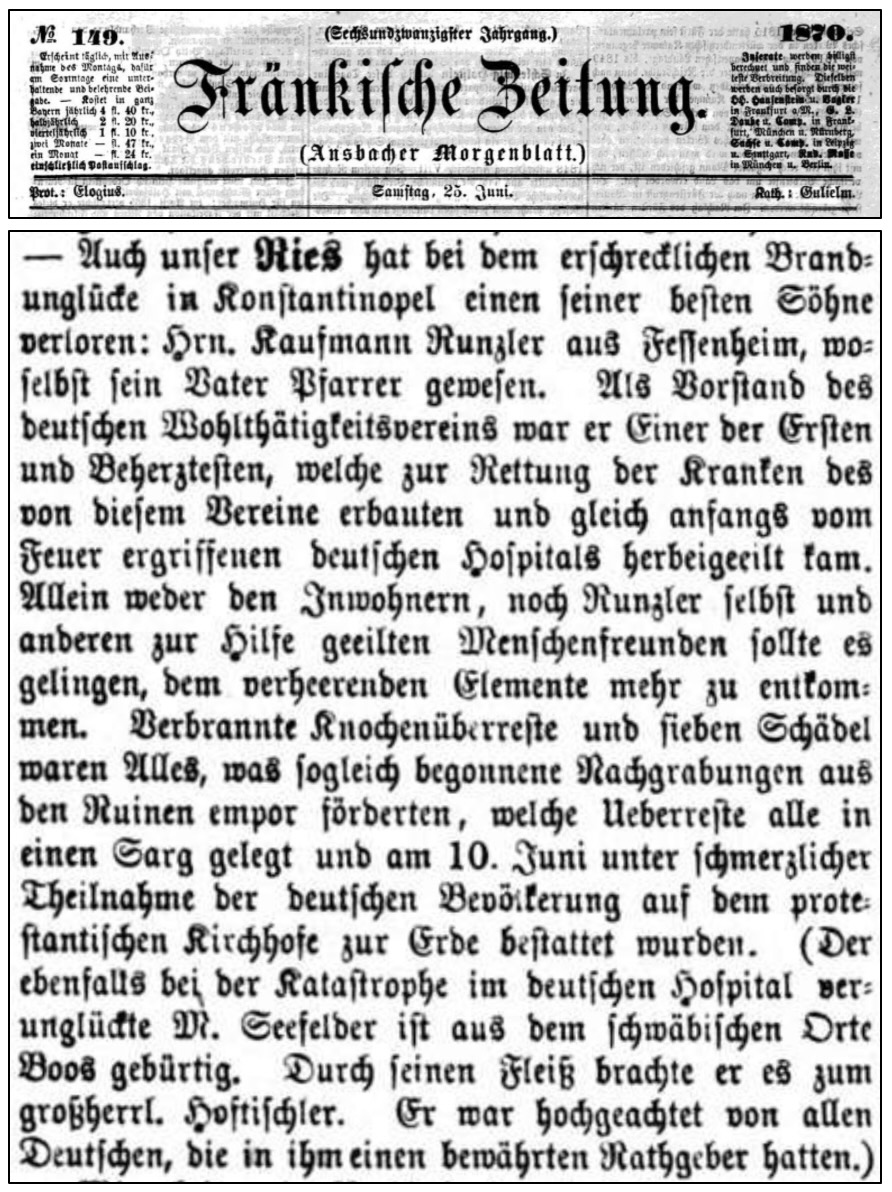
The death of Gustav Runzler in the Great Fire of Pera in 1870, mourned in the Fränkische Zeitung, Ansbach (Bavaria), 25 June 1870. Gustav was remembered as “one of the best sons” of the District of Reis, Bavaria. Similar obituaries appeared in no fewer than seven other Bavarian newspapers, some 30 years after Gustav had settled in Constantinople.
Another example: my family knew that my great-great-grandfather, Georg Heinrich Koch, had been invited to Constantinople in 1852 to “work in the Sultan’s gardens”, but our collective memory stopped there. My research revealed that Georg Heinrich and, later, his eldest son actually held the title of Head Gardener to the Sultan. Several academic articles have credited them – together with my great-grandfather Ludwig Georg Koch – with designing, creating and maintaining the royal gardens, especially those surrounding Yıldız Palace. Moreover, at some point during the reign of Abdülhamid II, Georg Heinrich was granted a large plot of horticultural land in Ortaköy in recognition of the services he rendered to the Sultan.
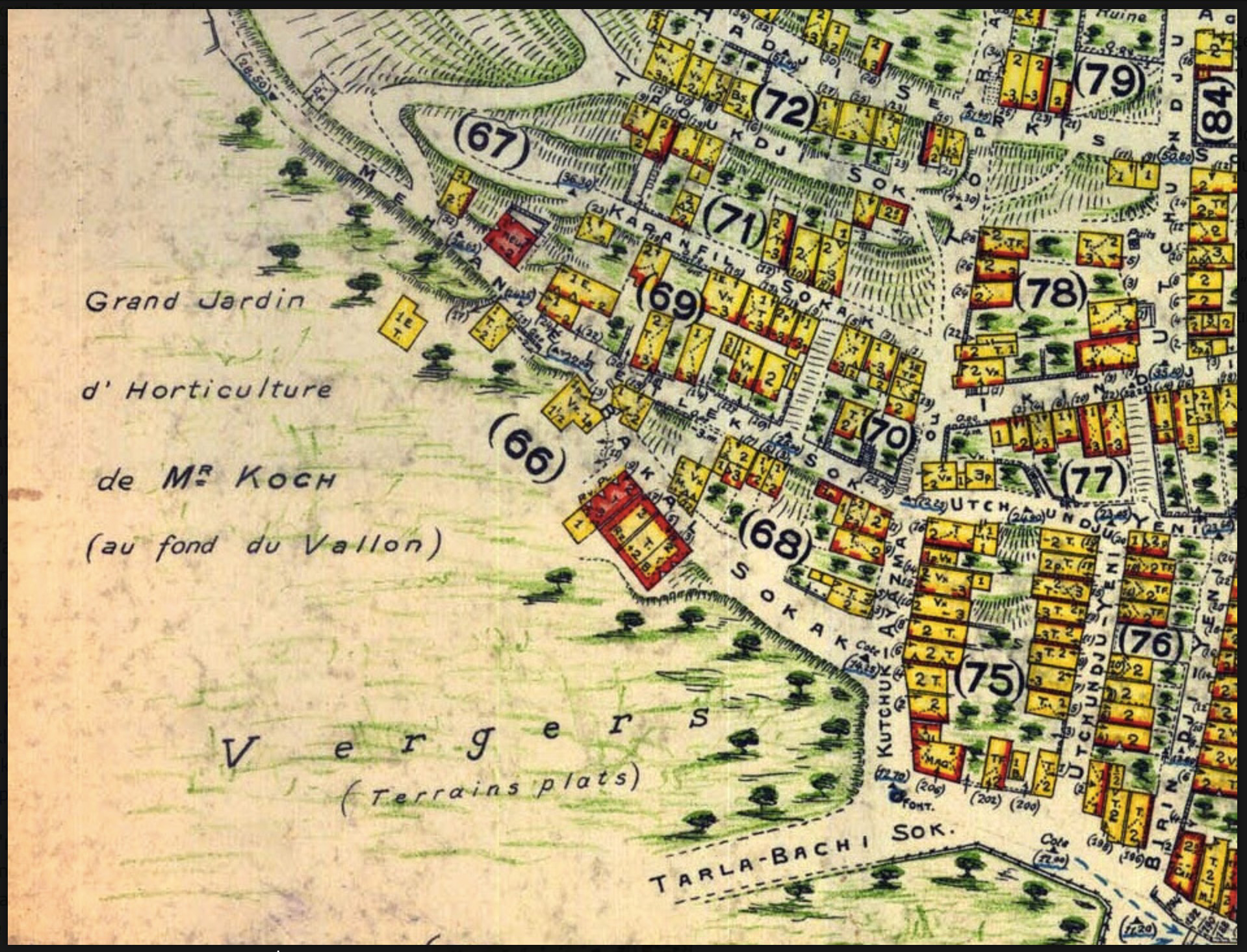
Close-up of the area marked as “Le Grand Jardin d’Horticulture de Mr. Koch”, Map of Ortaköy, Jacques Pervititch, 1927.
To me, these seem to be exactly the kinds of stories a family would wish to carry forward. Yet, with the passage of time, all this, and a great deal more, had been completely erased from our collective memory. Apart from a single effort by one of my great-aunts, who in 1937 recounted the history of the Widmann family business on six typewritten pages, it appears that generations of my family lived resolutely in the present, their gaze fixed firmly on the future.
I suspect this disinterest in the past was due, at least in part, to the extraordinarily turbulent events my family lived through during the first half of the twentieth century – among them the Young Turk Revolution and its aftermath; periods of serious economic hardship; two world wars and the associated deportations and internment that my own family endured; the “Citizen, speak Turkish!” campaign (Vatandaş, Türkçe konuş!); the Wealth Tax (Varlık Vergisi); and other measures targeting Turkey’s minorities. Much of what might have been remembered was bound up with loss – of status, of property, and of an entire world that those upheavals swept away.
For the generations preoccupied with constant adversity, dwelling on a vanished past likely offered little comfort or consolation. I think that what began as reticence in one generation hardened into simple ignorance in the next: you cannot miss, or think to ask about, what you never knew existed. And that is precisely what has made rediscovering my family’s past and restoring many of our ancestors to our collective consciousness so exciting and gratifying.
2- Your research has used multiple sources including maps with which you were able to pin-point locations of former homes and businesses. Did this spatial analysis also bring up other surprises, not necessarily connected with the various family branch ancestors, that was also a revelation for you?
The various maps of the late Ottoman and early Republican periods – notably those of Charles E. Goad (1904–1906) and Jacques Pervititch (1922–1945) – proved to be a treasure-trove of information and insight into my family history. These maps reveal how neighbourhoods like Galata and Pera were laid out; which communities clustered where; and the degree to which the built environment has since dramatically changed or disappeared altogether. The maps clearly illustrate the physical proximity and overlap of the old Levantine community: the embassies, schools, shops, photography studios, European post offices, hospitals, churches, synagogues, businesses and places of residence, all clustered within a very small radius. I have found these maps especially valuable for reconstructing streets and neighbourhoods of which few, if any, photographs survive.
Used in conjunction with the residential and business addresses recorded in successive editions of the Annuaire Oriental, these old maps offer something particularly gratifying: the ability to pinpoint the exact locations associated with each generation of my family. The maps even revealed place names connected to my family: the “Schorr Apartments” across from the Galata Tower, owned by my great-great-grandfather Leon Schorr; and the expansive “Grand Jardin d’Horticulture de M. Koch” in Ortaköy, owned by Georg Heinrich Koch.
They also allowed me to identify old buildings that still stand today – such as the Camondo Apartment Building on Felek Sokak, where two branches of my family lived during the first three decades of the twentieth century, and which in its twenty-first-century incarnation has become the DeCamondo Galata Hotel. These were especially exciting discoveries in an urban landscape that has changed so dramatically over the past century. One especially moving outcome of my research came in 2023, when my parents visited Istanbul and stayed at the DeCamondo Galata Hotel, in the same spaces that had been home to my father’s mother, grandparents and great-grandparents more than a century earlier. It was a unique and deeply emotional experience for all of us.
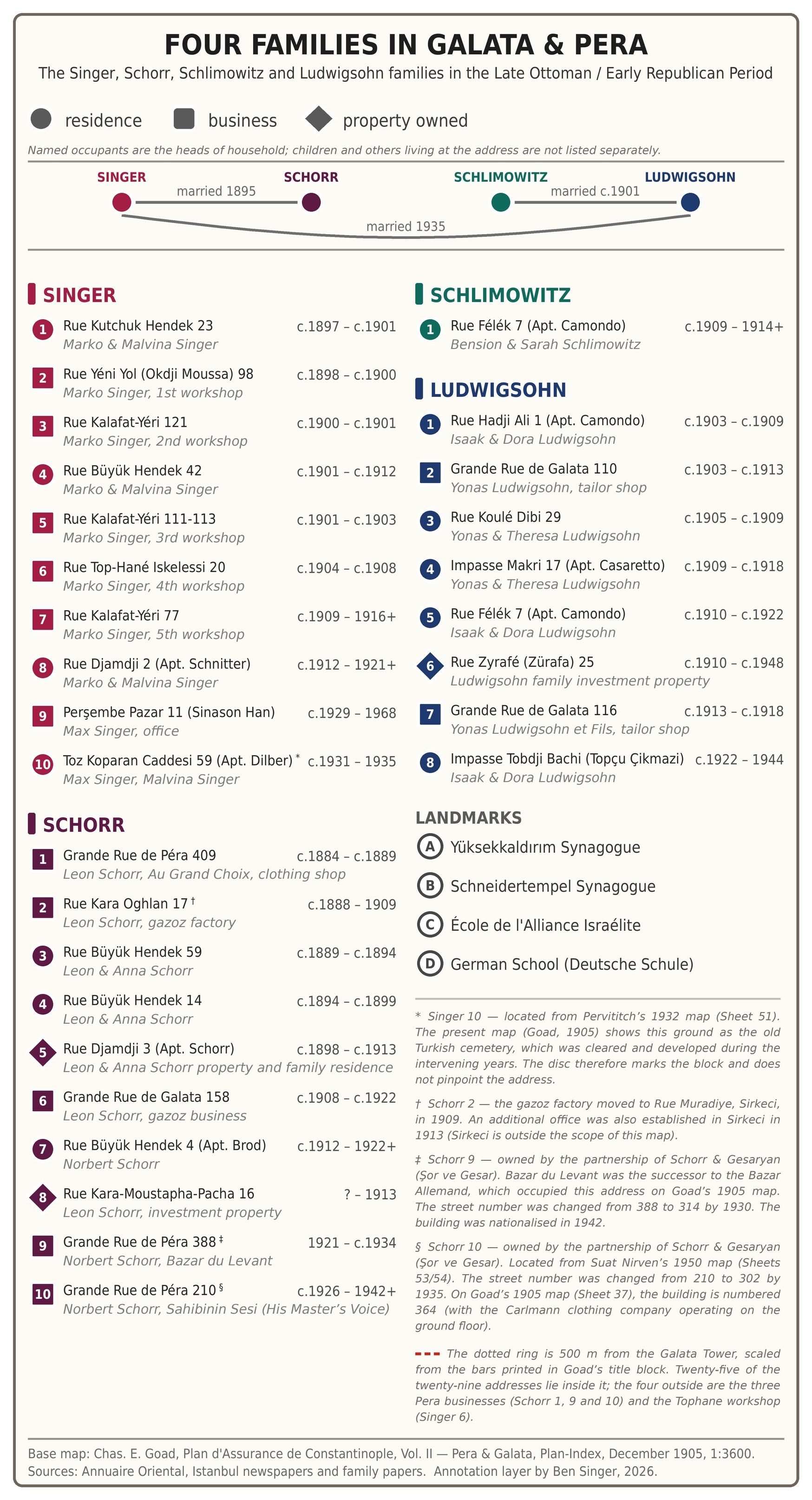
The maps also highlight the surprising proximity of the different branches of my own family more than a century ago. For example, plotting addresses on the maps revealed that three generations of the Singer, Schorr, Ludwigsohn and Schlimowitz families all lived within a 500-metre radius of the Galata Tower, even before becoming linked by marriage. Similarly, the Saury & Co. jewellery shop on the Grande Rue de Péra (İstiklal Caddesi), owned by my great-great-grandfather, Matern Saury, was situated only 100 metres from the apartment where my great-grandfather, Max Widmann, lived before he married Matern’s daughter, Mathilde Saury – my great-grandmother – in 1906.
The maps help restore the human texture of the old Galata and Pera neighbourhoods, much of which disappeared long ago: for instance, the foundries, forges, coffee houses and simple restaurants in the vicinity of my great-grandfather Marko Singer’s workshop on Galata’s Kalafat Yeri waterfront; or the immediate surroundings of Matern Saury’s jewellery shop, which included some of the most famous landmarks of the Grande Rue de Péra: the Sancta Maria Drapéris Church, the Sébah & Joaillier and Phébus photography studios, the Russian and Dutch Embassies, the Hôtel de la Grande Bretagne, the Brasserie de Strasbourg, the Pâtisserie Lebon, the Austrian Post Office, the Otto Keil bookstore, Zellich Fils stationery and printers, the Carlmann fashion house, and the Bazar Allemand and Bon Marché department stores. Such details vividly bring this vanished world back to life.
3- You were born in Istanbul so do you think this helped in your imagination of former lives and places of your ancestors and perhaps also their initial motivations for their move to Istanbul and reasons for branches to move away to foreign lands with time? Can you read Turkish and other languages in which family records and supporting information that was part of your sources? Which languages / scripts were the most challenging? Do you have any family documents in Ottoman script, or did you explore the possibility of hiring a researcher into the foreigners’ records in the Ottoman State Archives?
My early childhood in Istanbul and my return visits over the past few decades have undoubtedly helped me imagine the lives of my ancestors. The stories I heard from my parents and grandparents about their own lives in Istanbul have also given me a deeper understanding and appreciation of the texture and spirit of the city as they knew it.
Thanks to the wealth of surviving source material from the late nineteenth and early twentieth centuries, I have been able to discover a great deal about most branches of my family in Turkey. The most valuable of these resources include the Annuaire Oriental and similar directories from 1868 through to the 1930s; the Istanbul newspaper archives (both the Turkish and the foreign-language press); the Ottoman State Archives; the Gallica online digital library of the Bibliothèque Nationale de France; the online newspaper portal of the Münchener Digitalisierungszentrum (MDZ); the ANNO online newspaper portal of the Austrian National Library; the SALT Research Archives in Istanbul; and original nineteenth-century business letters which I have managed to acquire from stamp dealers and philatelic auctions.
I read French and German well, and both languages have been invaluable for working through newspaper articles, business advertisements, letters and other documents. My parents were happy to assist me in translating materials written in Turkish. It is also worth mentioning that AI-powered tools such as Claude and ChatGPT can now offer remarkably accurate transcriptions and translations, even of difficult-to-decipher old cursive scripts such as German Kurrent.
Newspaper Sources
I have found a great deal concerning my family in online newspaper archives: birth announcements, obituaries, community notices, business advertisements, property sales and other legal notices. These include both the Turkish press (Milliyet, Cumhuriyet, Son Posta, Vakit, Tan Gazetesi, Son Telgraf, Tasviri Efkâr Gazetesi, Sabah, Akşam Gazetesi, Haber, Vatan, and Servet-i Fünun) and the foreign-language newspapers published in Constantinople/Istanbul from the 1840s onwards (Journal de Constantinople, Courrier de Constantinople, Stamboul, L’Aurore, La Turquie, Gazette Médicale d’Orient, Türkische Post, and The Levant Times & Shipping Gazette).
One particularly poignant example of such a find is a community notice placed in L’Aurore in February 1915 and signed by my great-great-grandfather, Bension Schlimowitz, and a certain J. Miaskowsky. The notice advised that, with wartime blockades having cut off the usual imports of flour and matzah from Marseille and Galatz (Galați), the two had been entrusted by the Grand Rabbinate of Constantinople to produce part of the community’s Passover matzah that year. Orders could be placed at the oven on Felek Sokak or at a depot on Büyük Hendek Caddesi.
Several newspapers published in Austria and Germany (including Wiener Zeitung, Welt-Blatt (Vienna), Allgemeine Zeitung (Augsburg) and Augsburger Postzeitung) also covered the German-speaking community of Constantinople, and in them I have found numerous articles and announcements mentioning, or written by, my ancestors dating as far back as the 1850s. These include open letters championing various political and social causes of the German-speaking community in Constantinople, charitable campaigns, hotel guest lists, obituaries, and legal notices related to businesses registered with the Austro-Hungarian Consulate in Constantinople. One striking discovery is a public declaration – published in 1853 in several prominent German newspapers, and in a French version in the Journal de Constantinople – in which Constantinople’s German community sought to distance itself from the extreme anti-Ottoman rhetoric then circulating in parts of the German press over the persecution of Christian minorities, and to reaffirm its loyalty to the Ottoman Empire. The declaration was signed by the heads of the most prominent German commercial houses in the city, including Gustav Runzler.
Ottoman State Archives
In 2023, I engaged a Turkish researcher who tracked down more than thirty documents related to six of my ancestors in the Ottoman State Archives. Spanning the years 1879 to 1919, these include the imperial honours and state medals bestowed upon four of my ancestors; invoices dated 1881 and 1899 from Georg Heinrich Koch made out to Sultan Abdülhamid II for the sale of dozens of trees and plants destined for the Imperial Gardens; formal requests for payment from Matern Saury in respect of several gold timepieces and other precious objects that he sold to the Chief of the Imperial Wardrobe and the Palace Administration in 1879 and 1893; an innovative marketing arrangement between Leon Schorr and the Darülaceze Charitable Institution in 1903; a legal challenge brought by the Imperial Ministry of War against Leon Schorr in 1908; a batch of documents concerning a surprising attempt by Georg Heinrich Koch to establish Constantinople’s first modern zoo in 1890; and the transfer of eight acres of agricultural land in Ayazağa (just north of what is today Istanbul’s Maslak business district) to Ludwig Georg Koch in 1908.
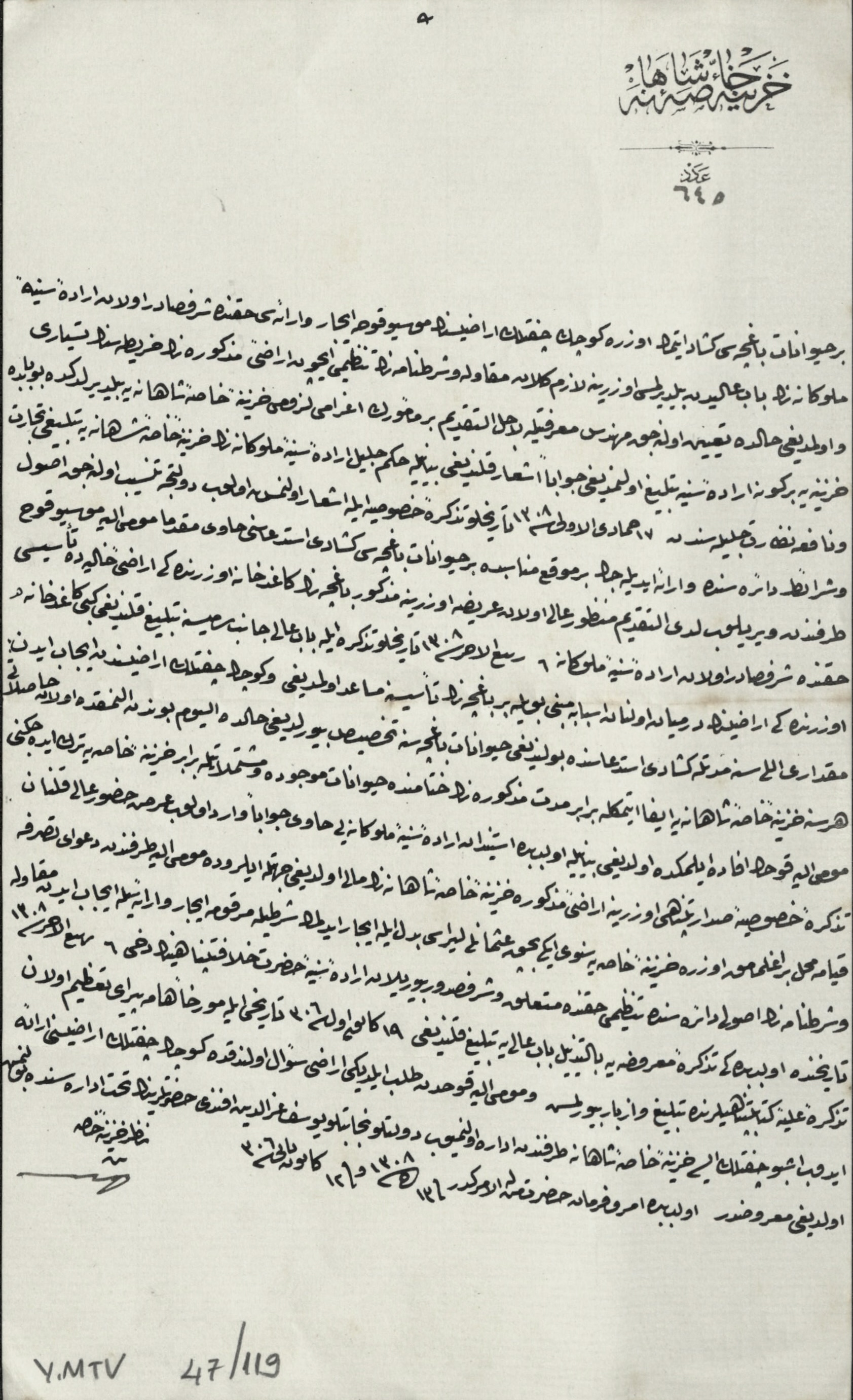
Official memorandum issued by the Hazîne-i Hâssa Nezâreti (Ministry of the Imperial Privy Treasury) concerning G. H. Koch’s proposal to establish what would have been the first public zoological garden in Constantinople, 24 January 1891. Ref.: BOA, Y.MTV.47/119.
Perhaps the most significant discovery in the Ottoman State Archives is a petition addressed to the Presidency of the Armistice Commission, dated 6 January 1919 and written in Ottoman Turkish by J.W. Heinrich Koch (my great-grandfather Ludwig Georg’s older brother). In this petition, J.W. Heinrich requested that he and the entire Koch family be exempted from the deportation orders that applied to all German and Austrian citizens living in Constantinople pursuant to the Armistice of Mudros. As Head Gardener of Yıldız Palace (as his father had been before him), his petition was granted, and the Koch family became one of the few German families permitted to remain in Constantinople during the years of the Allied occupation.
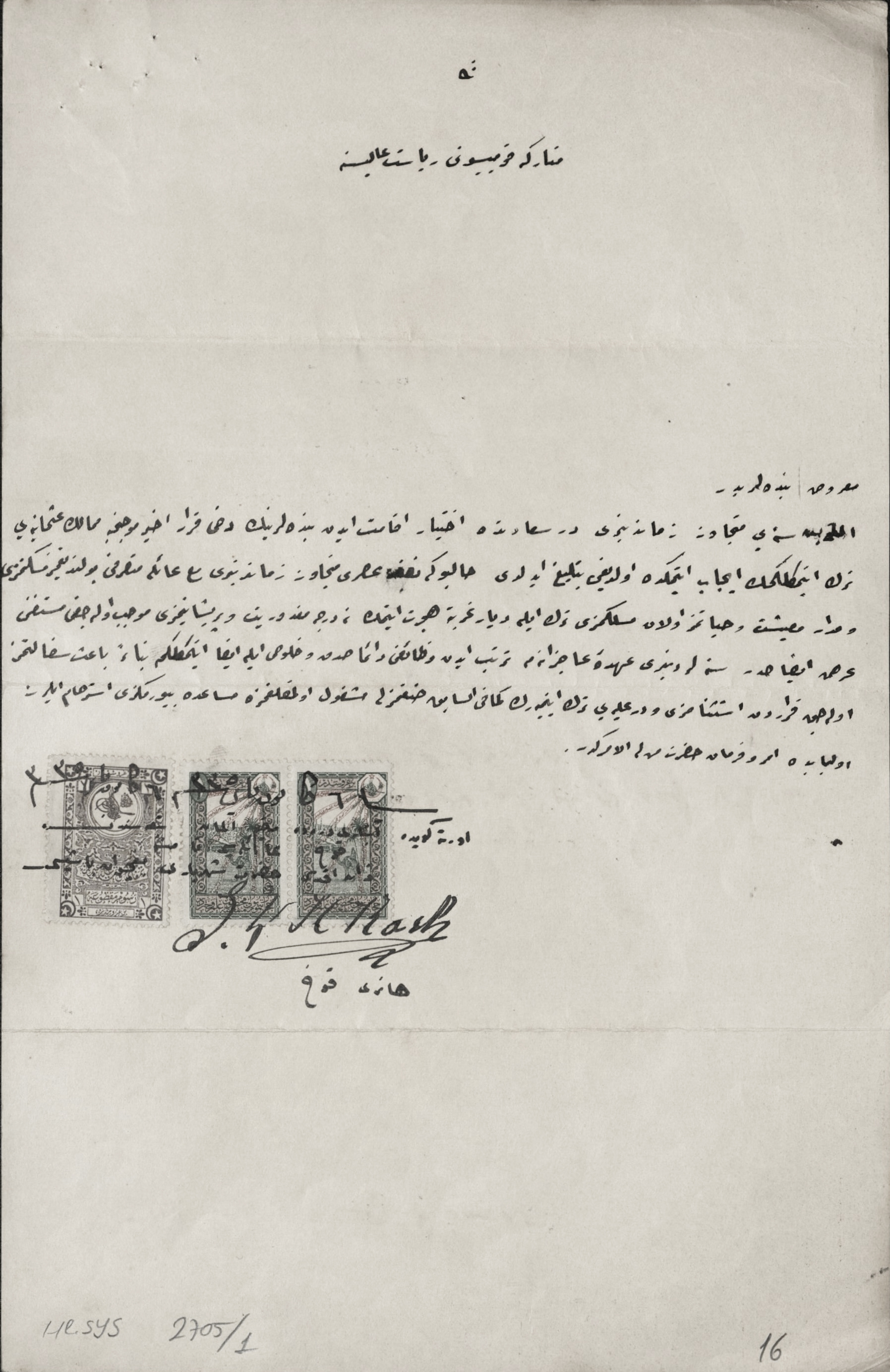
Petition submitted by J. W. Heinrich Koch to the Presidency of the Armistice Commission requesting exemption from deportation, 6 January 1919. Ref.: BOA, HR.SYS.2705/1.
These Ottoman Turkish documents presented the greatest translation challenge of my entire research. Fortunately, that same researcher who discovered the documents also proved to be an exceptionally talented translator: he rendered each document first into modern Turkish and then into English, in versions that are precise, faithful to the nuances of the originals, and careful to preserve their formal, period style. Their quality reflects his intimate familiarity with the language and the conventions of Ottoman-era writing.
When I first began my research, I had engaged a different Istanbul-based translator for two Ottoman documents already in my family’s possession – among them an 1894 deed transferring a parcel of agricultural land in Cendere to Ludwig Georg Koch. Those translations were stilted and disjointed. The contrast could not have been sharper, and it has left me all the more appreciative of the difference an experienced translator can make.
Business Letters
In recent years, I have acquired numerous historical documents connected to six branches of my family through philatelic auctions and rare-stamp dealers. Among them are complete business letters from the 1860s through to the 1890s, signed by my great-great-grandfather, Josef Widmann, which offer fascinating insight into the trading business he conducted, chiefly between Turkey and Europe.
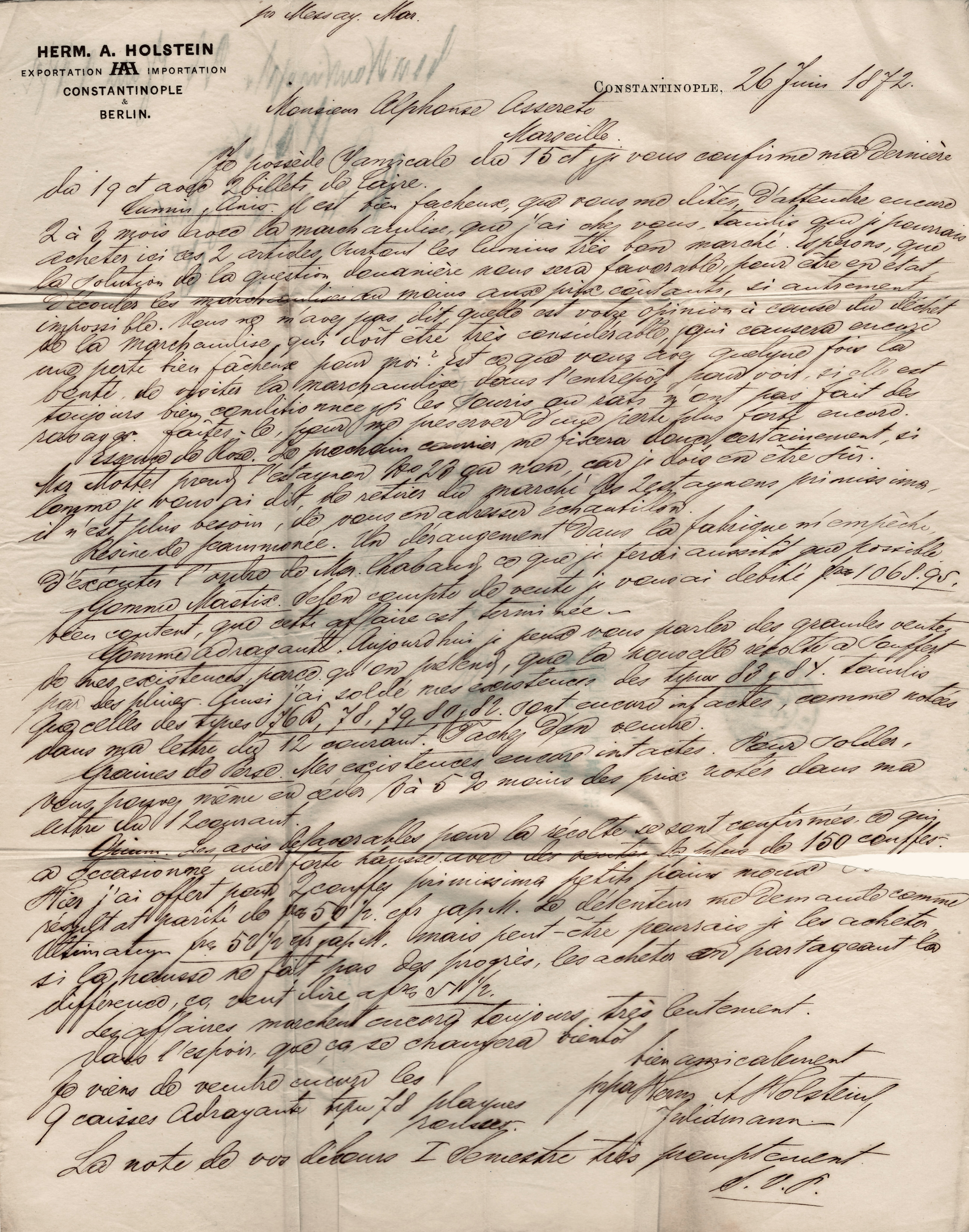
Letter dated 26 June 1872, written in French and signed by Josef Widmann on behalf of the Herman A. Holstein company, listing products for export to Alphonse Assereto of Marseille, France, including cumin, anise, rose essence, mastic gum, gum tragacanth, Persian lilac seeds, and opium. Acquired at a philatelic auction in 2023.
These letters reveal the extent of his trading links (Aleppo, Alexandria, Thessaloniki, Marseille, Strasbourg, Paris, Alsace-Lorraine, Vienna, Berlin, Dresden, Chemnitz, Odessa, and La Paz, Bolivia); the goods being traded (principally opium, along with a wide variety of agricultural products sourced from Anatolia and elsewhere in the Ottoman Empire and shipped to Europe as raw materials for the pharmaceutical, chemical and dyeing industries; and, in the other direction, fezzes, fabrics and haberdashery imported from Europe); as well as the shipping companies that made this trade possible.
I have also tracked down nineteenth-century business letters related to other branches of my family, revealing trading links to Cairo, Tunis, Bucharest, Birmingham, Lyon, Mainz, Basel, Madrid, Bohemia and Saxony; as well as additional lines of business – including the import of Austrian wines and the export of sheep intestines to Germany for use as sausage casings.
4- To what extent were your own family archives and photos properly annotated, or did you have to do plenty of cross-checks and reaching out to family members for face identifications etc.? Are there still mystery photos / documents to solve?
I am fortunate to hold a fair number of family photographs connected to all branches of my family taken at Constantinople photography studios (Abdullah Frères, Sébah & Joaillier, and M. Oko) between 1865 and the early twentieth century, as well as many photographs taken outside studios in the early decades of the twentieth century. Happily, almost all of these were carefully annotated on the reverse, so I have not been left with any mystery photographs to solve.
Through my research, I have also had the good fortune to reconnect with several relatives from branches of the family with which we had lost touch for the better part of a century – among them, two first cousins of my grandmother Batya, both still living, and a more distant cousin of my own generation. Between them, they shared some quite extraordinary photographs of the Schlimowitz and Runzler families from the turn of the twentieth century – images that finally put faces to names. Indeed, it was the first time I had ever set eyes on my great-great-grandparents, Bension and Sarah Schlimowitz.
5- The photograph with the 3 Schorr sisters taken ca 1893 show them all posing with Ottoman style semi-transparent lower face veils. Do you think this was a photography studio shot decision to make them look ‘Ala Turca’, or do you think so as not to attract undue attention these Jewish ladies dressed modestly like this when they went out on the street?
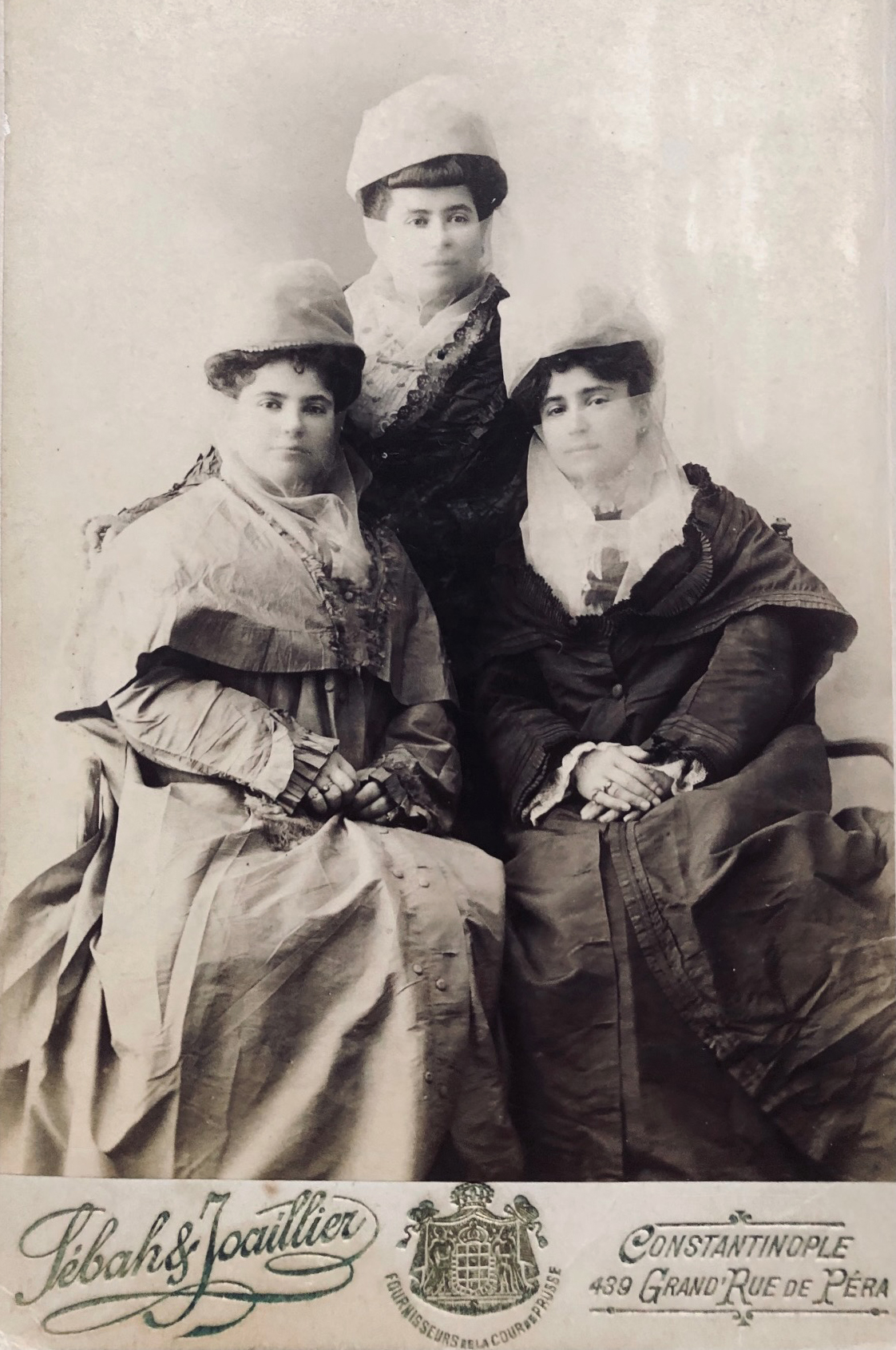
The three Schorr sisters (left to right: Eva, Rachel, and Malvina), Constantinople, c. 1893. Personal family collection.
In my opinion, this particular photograph of my great-grandmother Malvina and her two sisters, wearing the ferace and sheer, open yaşmak veils, was almost certainly a staged studio portrait. Though all three sisters were born in Constantinople, they remained Austrian citizens, spoke German at home, attended the city’s German School, and were strongly European in both cultural orientation and everyday dress.
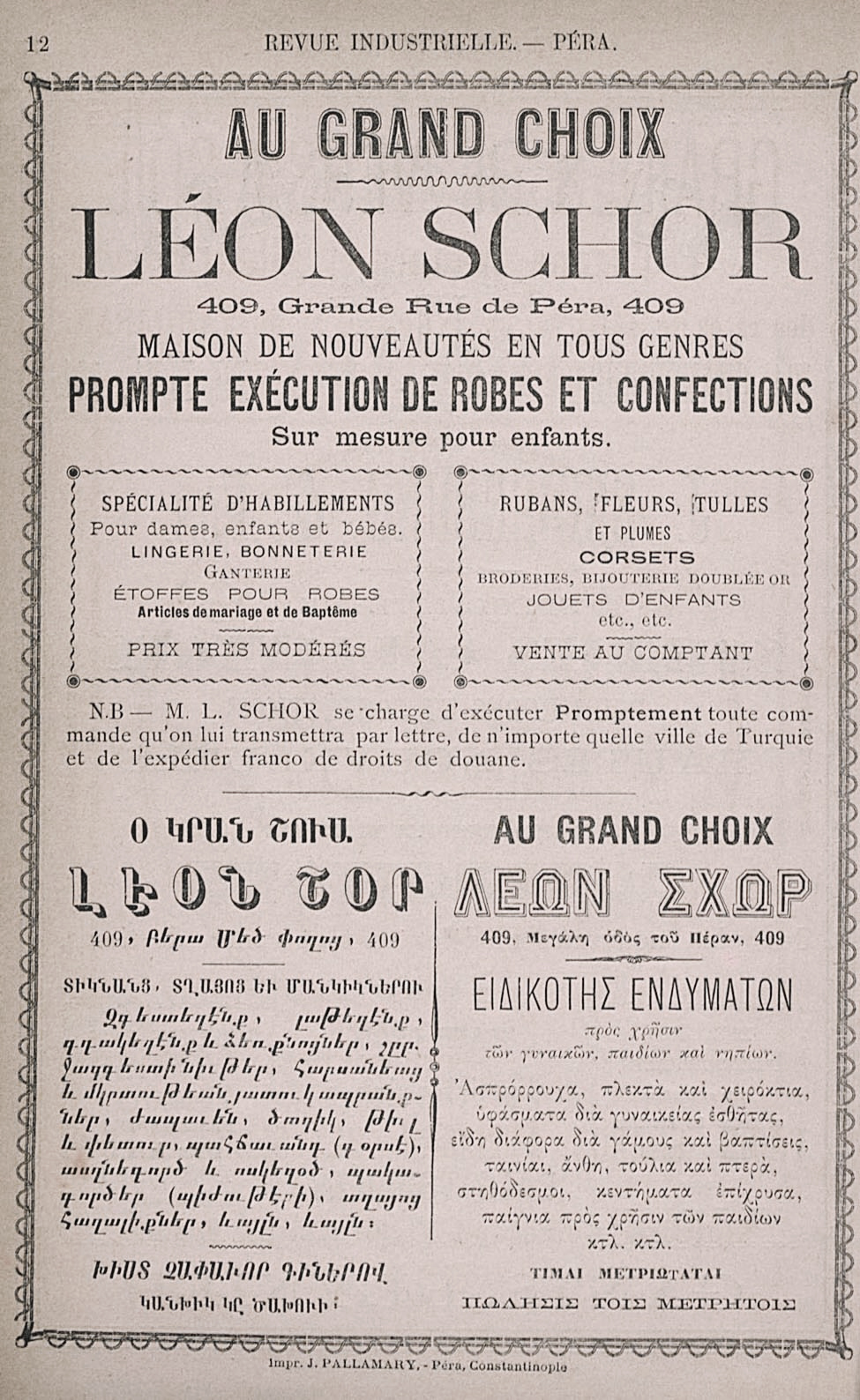
Full-page, trilingual advertisement for Leon Schorr’s clothing store for women, children, and infants on the Grande Rue de Péra, published in the 1885 edition of the Annuaire Oriental.
Leon Schorr, the father of the three sisters, arrived in Constantinople in about 1855 – from a town in the Austrian Empire I have yet to identify – and became a highly successful merchant whose commercial interests were far more integrated into the fabric of the Ottoman Empire than the businesses of my other ancestors. Leon’s company, an early bottler and distributor of gazoz and other non-alcoholic drinks, developed a philanthropic marketing arrangement with the Darülaceze Charitable Institution; supported wounded Ottoman soldiers being treated at Yıldız Hospital; and held properties under the waqf endowment of El-Hadj-Bahri-Mesdjid-Chérif (the noble prayer house of the maritime Hajj pilgrimage) as well as the Vakıf of Sultan Mahmud II (an Islamic charitable endowment established by the sultan during his reign and administered in perpetuity by the Ottoman waqf administration).
In the context of this branch of my family, the deliberate and elegant portrait of Leon’s three daughters in Ottoman dress strikes me less as a simple costume study than as a kind of cultural self-presentation – an expression of belonging to the city and the empire in the year after Ottoman Jewry celebrated the 400th anniversary of the 1492 welcome of Jews to Ottoman lands: a moment of pronounced Jewish-Ottoman pride and gratitude.
6- It is remarkable just how fluid the nature of nationality was with members of the same family holding different European citizenships and, in times of need, fighting and possibly dying in European wars, potentially on opposite sides. Do you think that nature of ‘nationality’ we know today is quite alien when applied to Ottoman minorities context and do you think that the chief motivation of your ancestors was not to obtain Ottoman citizenship as that would mean a heavy burden in terms of lengthy military service, and so when opportunities arose to obtain foreign citizenship, they couldn’t be too picky? Did any of your ancestors become Ottoman or Turkish citizens?
While two branches of my family held Ottoman/Turkish citizenship (starting from the mid- to late nineteenth century), the nine other branches continued to hold Austrian, German and French citizenship. In the aftermath of the First World War, the break-up of the Austro-Hungarian Empire cost two branches of my family their Austrian citizenship, which was then replaced by Polish and Italian citizenship. By the mid-1950s, one of my grandfathers, Max Singer, finally had his Austrian citizenship restored.
At least two generations of my family served in the Turkish/Ottoman military, including my father, who recalls his military service in Diyarbakır in the late 1950s with great fondness. One of my great-grandfathers served in the Ottoman army during the First World War. Other family members served in the French and Austrian armies during that same war, despite having lived their entire lives in Turkey. Robert Saury, a brother of my great-grandmother Mathilde Widmann (née Saury), was killed in action defending France against the invading German army in 1914, barely seven weeks into the war. I was born with Turkish citizenship – the fifth generation to hold Ottoman/Turkish citizenship along one branch of my family.
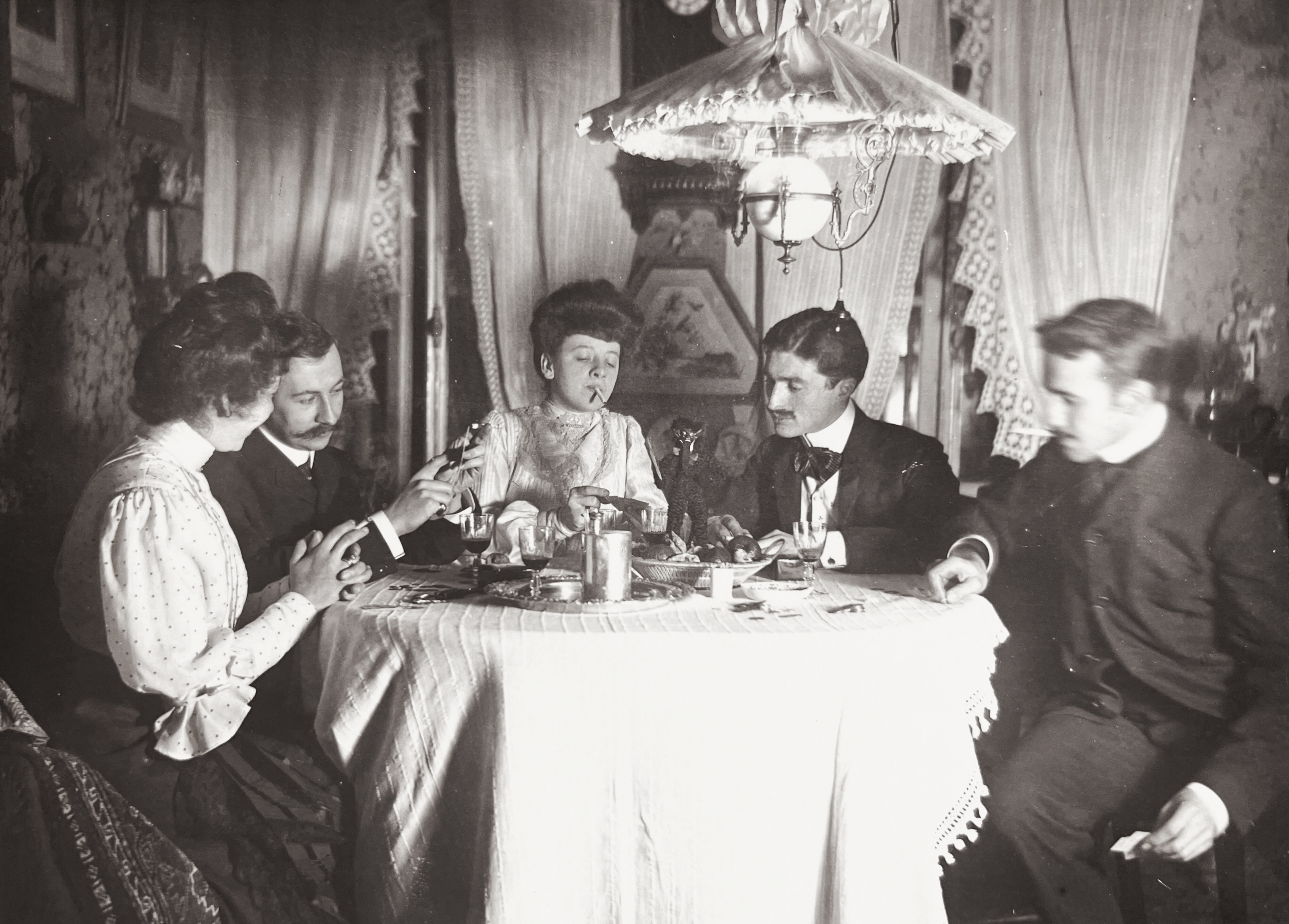
One family, three armies during the First World War. The three Saury siblings and their spouses playing cards in Constantinople, c. 1910. From left to right: Tilly Widmann (née Saury), her husband Max Widmann, her sister Alwine Jedermann (née Saury), Alwine’s husband Albert Jedermann, and their brother Robert Saury. At the outbreak of the First World War, Max, Albert, and Robert were conscripted into the Austrian, German, and French armies, respectively. Robert was killed in action just seven weeks after the outbreak of war while defending France against the invading German Army. Personal family collection.
While there were, no doubt, different individual relationships to citizenship and nationality within my family, the nature of nationality during the Ottoman period was on the whole very different from the way most of us understand it today. For those branches from Central Europe who settled in Constantinople in pursuit of better economic opportunities (Singer, Schorr, Widmann, Koch, Saury and Runzler), citizenship and European passports tended to reflect their cultural and linguistic identities. By contrast, the two branches fleeing persecution in the Russian Empire (Ludwigsohn and Schlimowitz) had no reason to cling to their former citizenship and were presumably glad to acquire Ottoman citizenship, which afforded them far broader civil rights than they could ever have imagined under Tsarist Russia. Indeed, my great-great-grandfather Bension Schlimowitz purchased Ottoman citizenship in the 1870s – years before he ever set foot in the Ottoman Empire – in order to escape the notoriously harsh military service imposed on Jewish recruits in the Tsar’s army.
Beyond the enduring cultural and linguistic attachments to their countries of origin, there were also significant economic and personal advantages to retaining European citizenship under the system of Ottoman Capitulations, whereby European residents and merchants generally enjoyed immunity from Ottoman legal jurisdiction as well as substantial reductions in, or even complete exemption from, local taxes and customs duties. A vivid illustration of this turned up among the Ottoman State Archive documents. In 1909, Leon Schorr petitioned the Austro-Hungarian Embassy in Constantinople to support a legal claim he had brought against the Ministry of the Interior and the Municipality of Constantinople: as an Austrian citizen, he argued, he should be exempt from a municipal levy on businesses operating horse-drawn carriages and delivery carts – a charge known as “pavement money”.
As much as any emotional ties to their ancestral homelands, the privileges under the Capitulations likely provided strong disincentives for most of my ancestors to relinquish their European citizenship in favour of Ottoman citizenship. This singularly complex and cosmopolitan world – with all its virtues and failings – came to an end with the collapse of the Ottoman Empire and the rise of Republican Turkey.
The most dramatic reversal of the privileged positions enjoyed under the Capitulations came in January 1919, when almost all Austrian and German citizens living in Constantinople were deported to their “home” countries pursuant to the Armistice of Mudros. Among them was the Widmann family – including my grandmother Mädi, then a young girl – who did not return to Constantinople until 1924. A generation later, in the autumn of 1944, almost all Austrian and German citizens living in Istanbul were either deported or interned in one of three towns in central Anatolia – Yozgat, Kırşehir and Çorum. My mother, an infant at the time, was interned with her family in Çorum for just over two years, returning to Istanbul in early 1947.
7- The nature of businesses pursued by your ancestors were as varied as their origins and in some cases the businesses seem to have been also ‘multi-tasking’. For example, in the case of Josef Widmann he exported both from Anatolia pharmaceutical raw products to a whole variety of European nations while also importing exotic products such as rubber. Do you think merchants such as Widmann had good ‘information networks’, possibly family members, based in other countries to gain a good insight on needs of specialist goods and so a team effort? Do documents give any hints to such ‘market research networks’?
Several branches of my family were traders and brokers, beginning in the early 1840s (Runzler), 1862 (Widmann) and 1929 (Singer). Although they generally did not rely on family networks, they certainly drew on their cultural and linguistic roots in Europe to build an extensive web of strong business connections, some of which lasted for decades. Given the many uncertainties involved in international trade at the time, trust was an especially important element in these relationships, and it was undoubtedly easier for my ancestors to establish enduring ties with customers and suppliers in Germany, Austria and France.
One type of network that both the Widmann and Runzler family businesses made good use of was that of German-speaking traders outside of Germany and Austria – in France (Paris, Marseille and Alsace), Spain (Madrid), Eastern Europe (Odessa) and South America (La Paz, Bolivia), as well as in various corners of the Ottoman Empire. Although French was the principal language of Levantine trade – and one in which my ancestors were themselves entirely at home – there was a natural fraternal warmth in dealing with their German-speaking counterparts, and that rapport paid commercial dividends: a shared mother tongue reinforced the trust and goodwill on which favourable terms and lasting business relationships often depended.
Another fruitful network was rooted in their ties to chambers of commerce. In 1858, my great-great-great-grandfather Gustav Runzler – himself born in Bavaria and established as a broker in Constantinople from the early 1840s – granted a position in his company to a young Viennese merchant named Ferdinand Leithe. Described as an apprentice, Leithe was sponsored by the Viennese Chamber of Commerce with the aim of acquainting him with Levantine trading practices and generally strengthening the trading relationship between Vienna and Constantinople.
In 1860, Gustav presented the Viennese Chamber of Commerce with a report setting out his advice on promoting Austrian goods in Constantinople, which the Chamber duly circulated among the city’s business community. He cultivated these relationships over the following years, and he and his sons went on to become highly successful brokers, handling a wide range of products traded between Austrian and Ottoman firms.
Members of both the Runzler and Widmann families also held senior leadership positions in Constantinople’s Austro-Hungarian Chamber of Commerce between 1897 and 1915, including the Chamber’s presidency. This undoubtedly enhanced their standing as trustworthy brokers for European companies seeking to forge trading relationships with the Ottoman Empire.
You mention “multi-tasking” and, indeed, diversification was a hallmark of the Widmann and Runzler family businesses. Like many commercial houses in nineteenth-century Constantinople, both firms operated in many capacities at once – as merchants, commission agents, brokers and financial intermediaries. Josef Widmann was first listed in the 1888 edition of the Annuaire Oriental as a businessman engaged across many fields: “banker and trader, exports, imports, commissions, representations, collections and recoveries.” Josef even represented the Constantinople-based Crédit Général Ottoman during its liquidation in the mid-1890s.
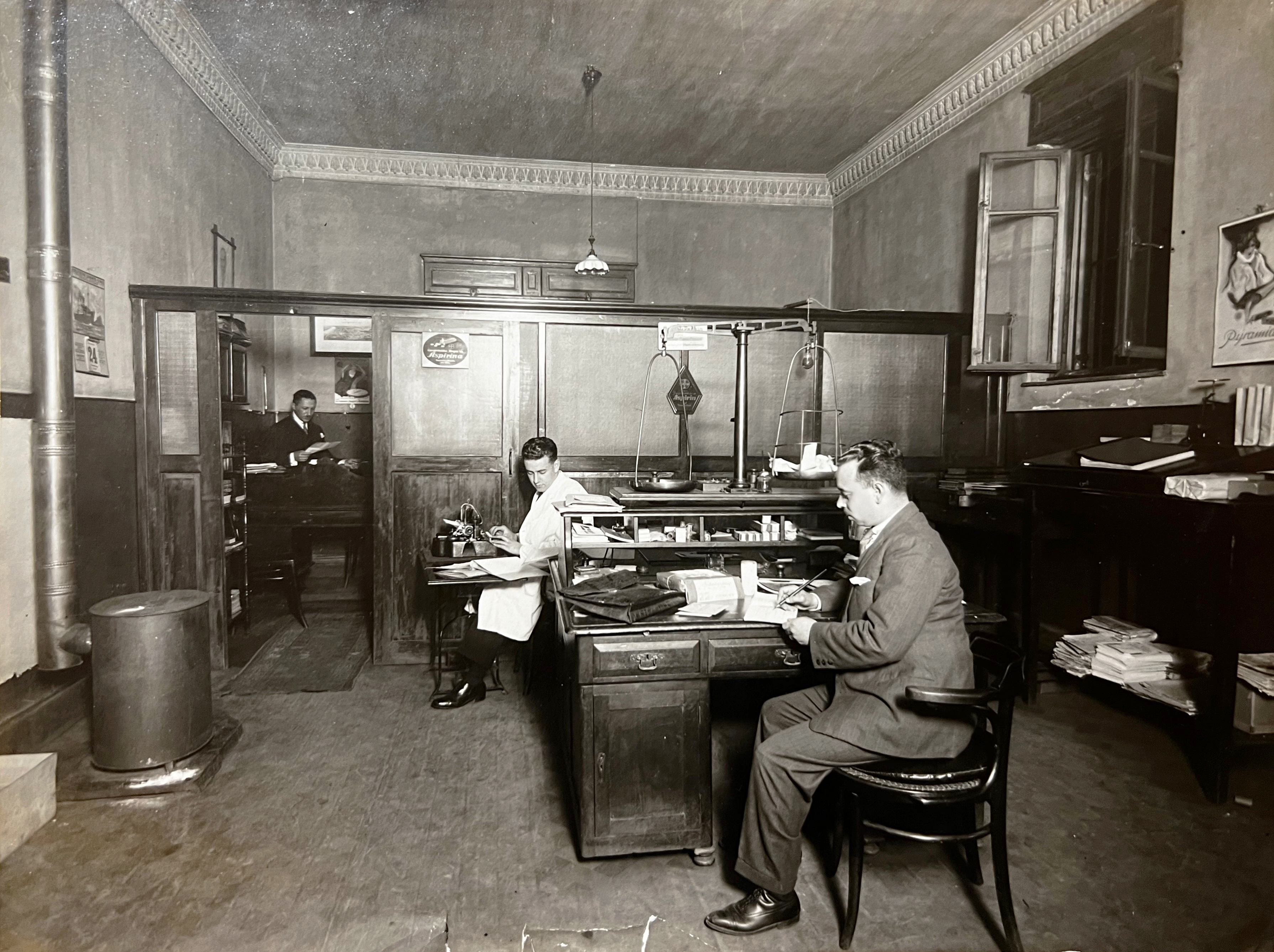
Three photos taken in the offices of Widmann & Co., Sirkeci Palas, Constantinople, c. 1929. From left to right: Gustav Widmann, Herbert Widmann (Gustav’s son), unidentified man.
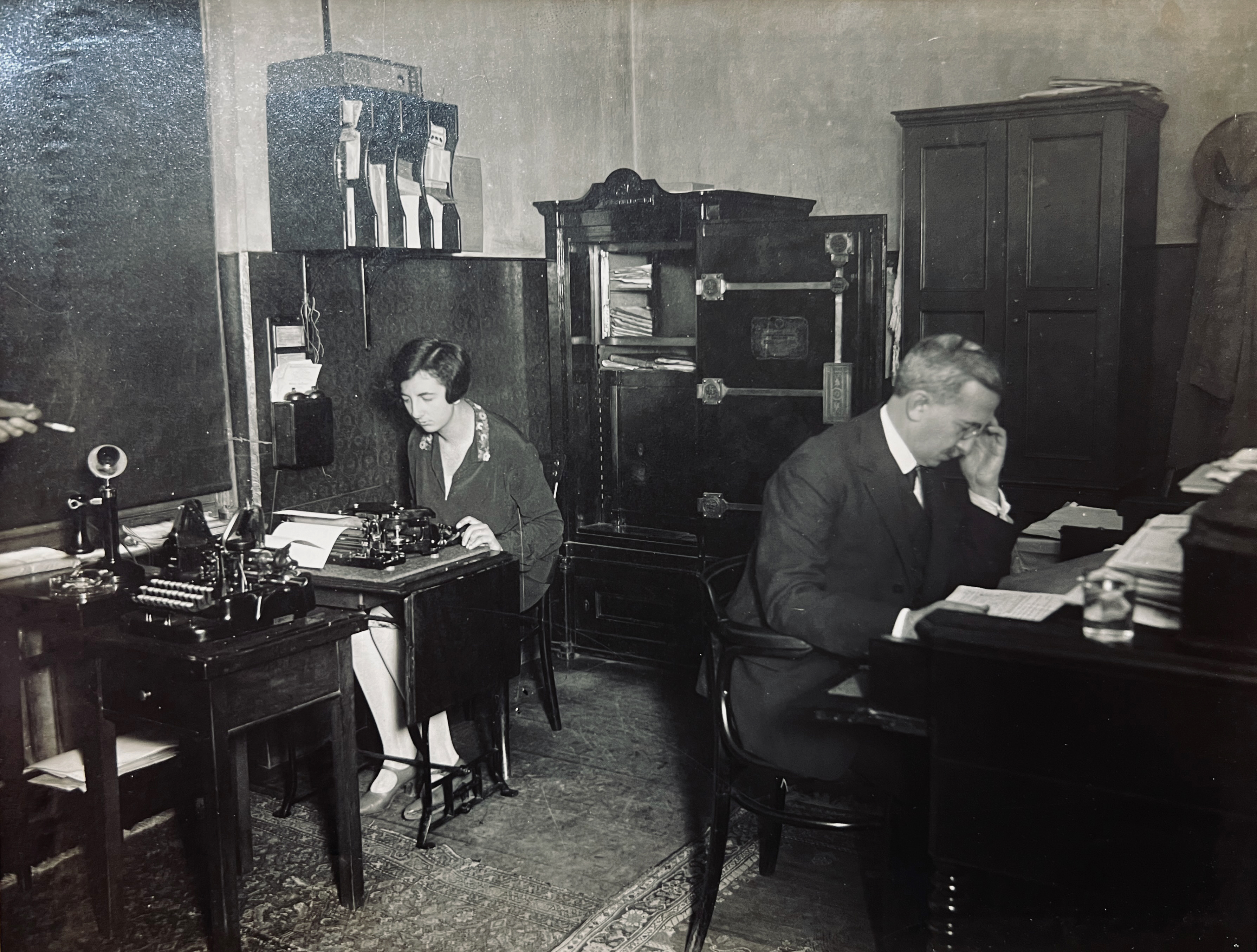
From left to right: Elisabeth Bruckner (née Widmann), Max Widmann (Elisabeth’s father).
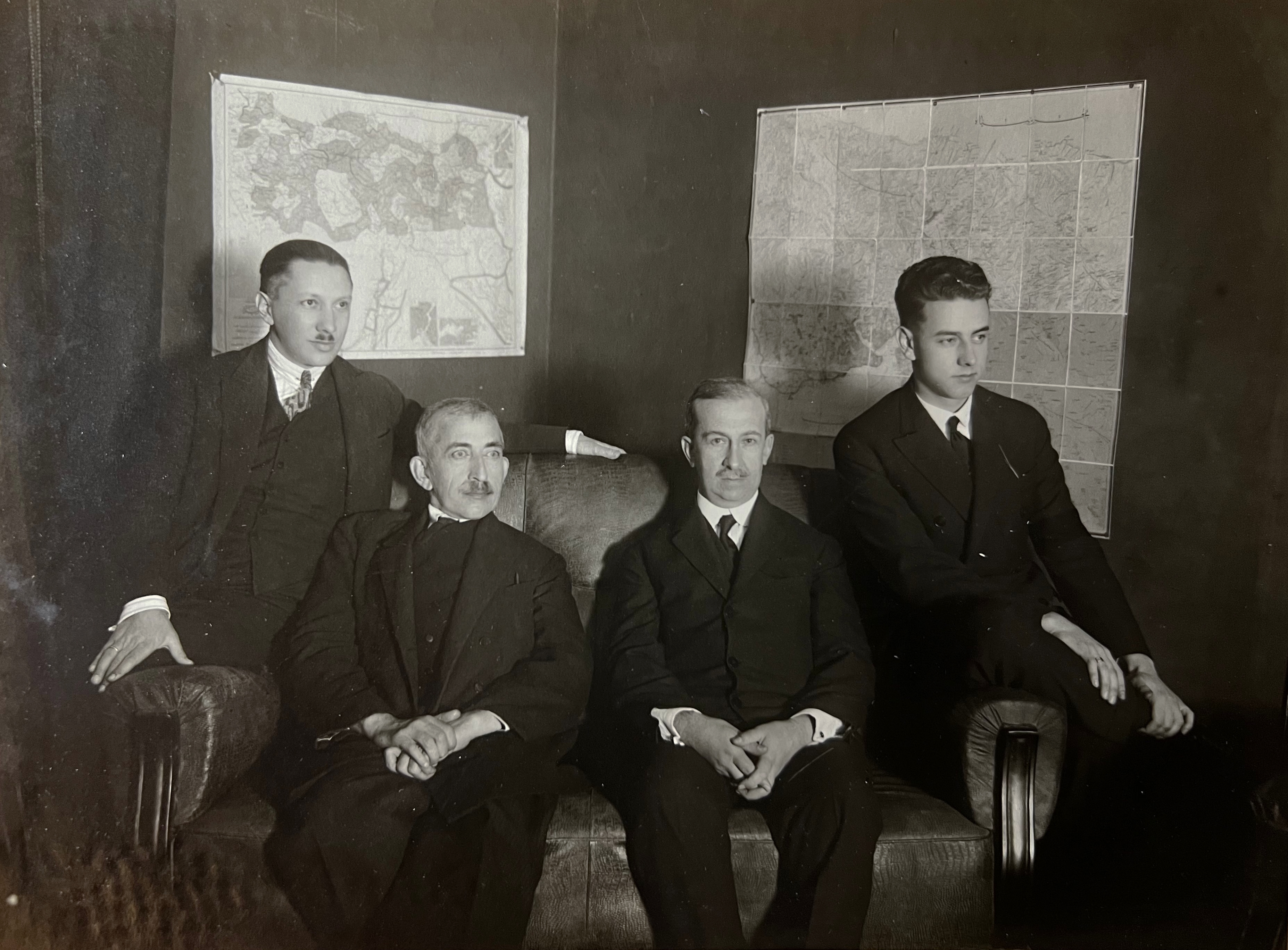
In this photo left to right: Gustav Widmann, Dyonis Rigopoulos (who maintained the family business from 1919 to 1924, after almost all Austrian and German nationals were expelled from Constantinople), Max Widmann (my great-grandfather) and Herbert Widmann. Personal family collection.
However, such broadly diversified operations became less common by the early twentieth century. By the 1920s, Widmann & Co. had shed most of its agricultural export trade and had come to specialise in the import of pharmaceuticals, industrial chemicals, microscopes and precision laboratory optics – all sourced from Germany and Austria. In the pharmaceutical field, the firm represented the Bayer Company, introducing aspirin, anti-malarial drugs and other medications to the Ottoman and Turkish markets.
8- You have outlined the lives and times of 11 family lines that are part of your family heritage. Do you think this is the ‘natural limit’ of meaningful research, or could you also have the future motivation to go deeper into side branches?
My research has focused on my direct ancestors along the eleven family lines that first settled in the Ottoman Empire between the 1730s and the 1890s, whose lives I have traced through the generations down to my own family’s departure from Turkey in 1970. Yet even when my research has carried me further back in time – to the generations who lived in Europe – I have continued to focus on these same family lines and surnames, which for me is the “natural limit” of my genealogical research. After all, if every family line were traced back successfully, the tenth generation alone would already exceed a thousand individuals.
My continuing research interest lies chiefly in tracing several more of my family lines further back, to their places of origin before they settled in Constantinople. For three of them, I have already been able to do this in considerable depth and colour – the Runzler, Widmann and Koch lines back to 1522, 1785 and the 1690s respectively – thanks in large part to well-preserved and accessible archives in Germany and Austria. Perhaps most remarkable of all has been my discovery of Melchior Runzler, a direct ancestor fifteen generations back, who served for twenty-three years as the Lutheran Superintendent of Nördlingen, in what is now Bavaria. Alongside a painted portrait of Melchior from the late 1500s, I have also unearthed a nine-page elegy, a carmen funebre, in his honour. Composed in Latin by a deacon of the town and published posthumously in 1580, it traces Melchior’s life from his origins in Mittweida, in Saxony – through his studies at the University of Wittenberg, his associations with leading figures of the Reformation (including Philipp Melanchthon), and his own beliefs and teachings – to the circumstances of his death in 1578.
For several other family lines, however, the trail runs cold far sooner – at the very point of their arrival in Constantinople in the mid- to late nineteenth century, beyond which I have not yet been able to trace their exact origins. The Singer and Schorr families are among these, and I am currently in contact with the Austrian State Archives (which hold vital records of Austrian citizens who resided in Constantinople during the late Ottoman period) in the hope of establishing the specific towns or villages they came from. Those long-forgotten birthplaces would reveal so much more about these two family lines: the lives my ancestors led, and the world they left behind. Their origins were a mystery even to my grandparents, and it is thrilling to be, at last, on the cusp of a breakthrough.
9- What was the family motivation to leave Istanbul and how many family members still live in that city?
During its cosmopolitan era, Constantinople offered my family unprecedented opportunities and every reason for optimism. Yet the twentieth century brought rising nationalism, xenophobia and discrimination that repeatedly challenged our sense of belonging. My immediate family left Istanbul in 1970, at a time when many minority families came to the bitter conclusion that they no longer had a future in Turkey – the country which we loved and called home for generations. I was five years old.
While I still have a few cousins in Istanbul, almost all our relatives and my parents’ closest friends left by the early 1970s – to build new lives in Europe, Israel, North America and Australia.
To contribute to this ongoing study, please contact me on
Interview conducted by Craig Encer
24th online presentation with guest speaker Ben Singer: ‘Rediscovering the Diversity of a Levantine Family – the Jewish, German, Austrian, French and Armenian branches of One Istanbul Family’, 26 February 2023 - flyer:
Additional resources provided by Mr Singer to help in spatial visualisation of past residences of family branches
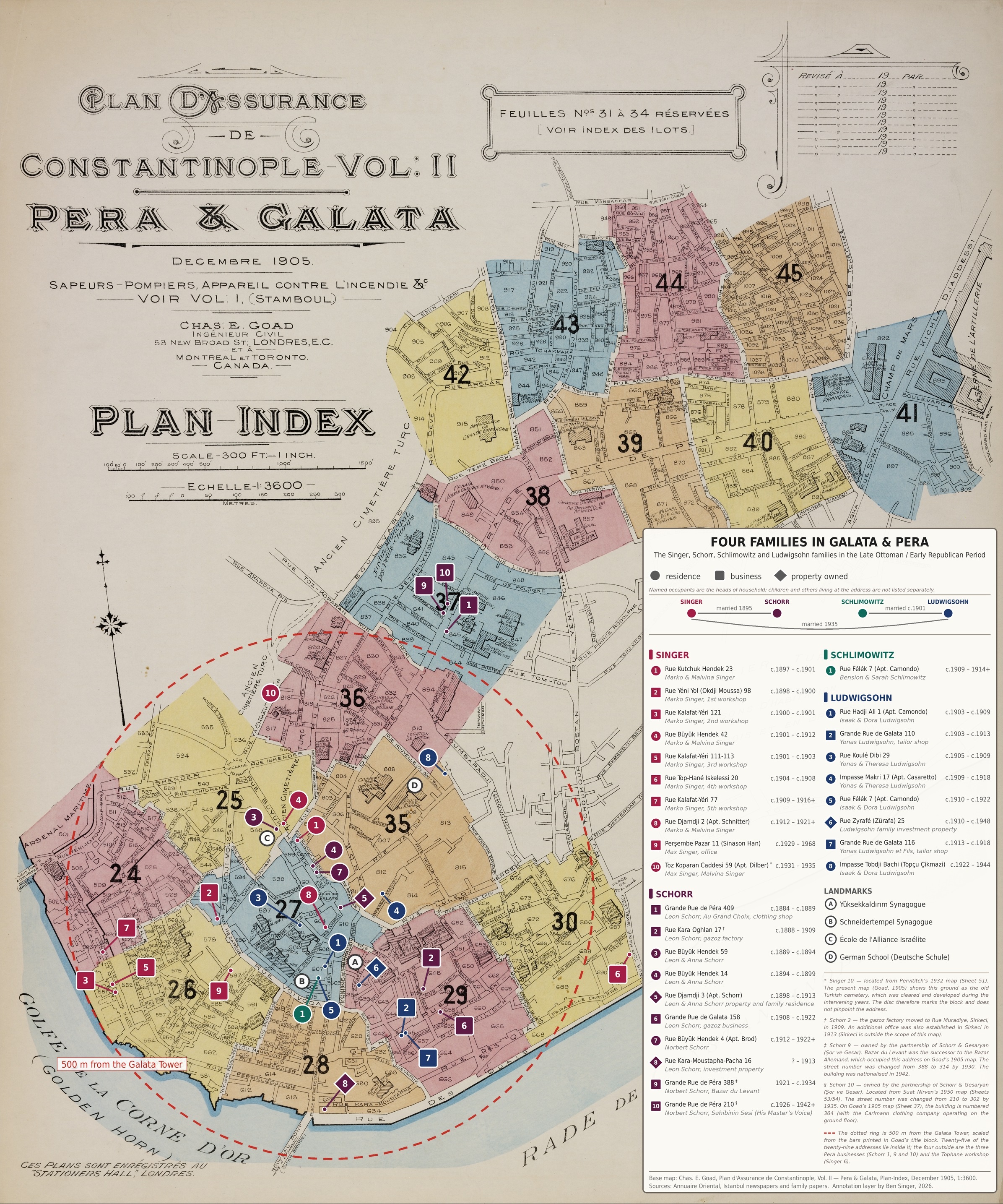
Roll-over image to view unannotated version of the map - click on the annotated map to view a higher-resolution version.
I decided to use Charles Edward Goad’s 1905 Plan-Index to plot the addresses of four branches of my family during the late Ottoman and early Republican periods. While Jacques Pervititch’s maps are more detailed (1:500 against Goad’s 1:3600), each sheet covers only a few blocks, and these addresses run right across Galata and Pera. No single Pervititch or Goad sheet can hold all of them. Goad’s Index puts both Galata and Pera on one sheet at a consistent scale, which is what makes a single map possible at all. The dates fit better too: most of the addresses fall between 1884 and 1922, so a 1905 survey sits roughly in the middle of the period rather than at the end of it.
I have made a special effort to to pinpoint the addresses on the map. Every address carries a small dot that anchors its position on the map, joined by a line to its numbered disc. The disc is displaced only so that the numbers stay legible where addresses cluster - the dot marks the actual position of each address.
Close-up views using The Charles Goad Map Sheets (1904/05)
Street names follow Goad’s 1905 French forms throughout, so that every address can be checked against the lettering on the Plan-Index and on the individual sheets (24–30, 35 and 37). To find these streets on a modern map of Istanbul: Rue Kalafat-Yéri is now Üsküfçüler Sokak, Rue Djamdji is now Camekan Sokak, Toz-Kaparan Caddesi is now Refik Saydam Caddesi, Impasse Tobdji Bachi (Topçu Çıkmazı) is now Seraskerci Çıkmazı, the Grande Rue de Galata is now Necatibey Caddesi, Rue Kara-Moustapha-Pacha is now Kemankeş Caddesi, Rue Koulé Dibi is now Galata Kulesi Sokak, Impasse Makri is now Tatar Beyi Sokak and the Grande Rue de Péra is now İstiklal Caddesi. - view full sized annotated map - unannotated map: